
How long have you put your thesis on hold? It’s time to get started! Keep reading if you want to make it easier to begin.
Once you’ve completed your degree program and passed all your courses, your final challenge is to write a thesis in order to earn your degree. Of course, at many universities this isn’t the only way to graduate, but at others it is—as was the case for me.
An engineering or undergraduate thesis is an argument on a specific topic, typically between one hundred and four hundred pages long. The student must address a problem at their university or at a company where they have chosen to complete an internship, placement, or community service. The thesis is developed using a consistent research methodology.
The time required varies depending on your university’s requirements and your own needs or goals. In my case, it was mandatory to complete it in one academic term (4 months). In addition to conducting the research, you must present your thesis to a panel, which will decide whether to approve it.
Choose a Topic

This is the most important and fundamental step in getting your thesis started, but at the same time, it’s the most daunting. Your topic could be easy, or it could be very difficult and broad.
In my case, when I started my professional placement (community service or residency), the university helped me find a place to complete it. However, it’s important to remember that the student is primarily responsible for finding a company where they can address a problem within a period of 4 months. The topic is chosen together with the company supervisor and academic advisor. In other cases, students receive no help at all and have to define the topic entirely on their own. I think that’s better because you can choose a topic that interests you. If the project is going to take 4 months or more, at least make sure it’s something you enjoy 100%—otherwise, it will feel like a chore.
One tip is to do a personal SWOT analysis. This can help you come up with ideas, since a SWOT analysis focuses on your strengths, weaknesses, opportunities, and threats. Try to approach it from a more professional perspective. Remember that once you finish your thesis, you graduate: goodbye school, hello working world! Focus on what you want to do for a career. That way, when you want to start your own business or apply for a job, you’ll have a thesis project to draw on, which will add credibility and professionalism.
If you’re completely lost and don’t know what you want to do or how to get started, don’t worry! There’s a solution to everything. You can get some inspiration by searching for theses online. You don’t have to copy one exactly—you can put your own spin on it and make it your own.
Choosing an Advisor

After choosing your topic, it’s important to choose your thesis advisor.
First, make sure this person has experience in your chosen topic. Second, don’t choose an advisor just because you “like” them—those are two very different things. Finally, consider whether you’ve worked with any of your professors during your degree program. This can help you feel more comfortable when it’s time to work on your thesis. It’s very important to feel at ease, since this is a long-term project.
In my experience, we weren’t allowed to choose our advisor at my university. If you can choose yours, you’re in luck! It may not seem like it, but your advisor has a big impact on your project’s development and quality. I had a professor with whom I hadn’t had a good relationship throughout my degree program. Things were uncomfortable between us. When it was finally time to work on my thesis and placement (community service, internship, or residency), I kept hoping she wouldn’t be assigned to me—and guess what… she was my advisor. It was incredibly uncomfortable, but I had no choice but to remain professional. In the end, we managed to establish an acceptable professor-student relationship.
Defining the Structure

This helps organize your project. In my case, my advisor gave me a template explaining how to put the thesis together step by step, including sections such as:
-
- Cover pages
- Back covers, abstract
- Introduction, table of contents
- Company description
- Rationale
- Chapter Structure
- Methodology
- Writing, font size and type, alignment, spacing, subtitles
This will vary depending on the information your university requires for your thesis. If your situation is different and your advisor doesn't provide you with a thesis structure, don't worry. I'll keep saying that you can find thesis examples, thesis-writing guides, and thesis structures online, so there's no excuse not to get started.
[irp posts=»698″ name=»5 tips for reading more and better»]
Create a project schedule
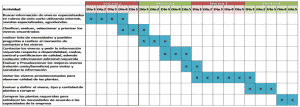
Once you've settled on your thesis topic and structure, you can move on to the second step: creating a schedule of activities. I made mine in Excel, but you can also do it more easily in Word or on whichever platform you prefer.
You can create it with your advisor to organize the time needed for the project. As I mentioned earlier, the timeframe may vary, starting at 4 months.
Creating a schedule of activities doesn't mean you have to follow it to the letter. It can change over time as activities are added or removed. It's important to set deadlines and, above all, take responsibility for reviewing it regularly.
If you don't know how to create a schedule of activities, you can find free online platforms, download one, and adapt it to your preferences. You can also find plenty of videos online explaining how to create this type of schedule.
Work Environment

There's a lot of work ahead, so you might as well get comfortable.
If you're allowed to work on your project during your placement (internship, residency, or community service), alongside your regular duties at the company, take advantage of it! Time is precious, so don't waste it. Spend at least 4 hours a day on your thesis.
It's important to keep up with your schedule of activities; you decide which days you'll work on your thesis. If you can't work at the company where you're doing your placement, I suggest setting up a space at home. Make sure it's comfortable, creative, spacious, and, above all, somewhere you can concentrate—in other words, somewhere completely quiet. If neither of those options works for you, you could try the nearest library that you like.
You can listen to music while doing research, but my advice is to listen only to your own thoughts when you're writing.
[irp posts=»605″ name=»5 tips for maintaining and improving your professional image»]
Sources and Writing

Now for the good part!
This may be the most challenging part of your thesis—not exactly difficult, but tedious. Let me explain why.
When developing your thesis, you'll write sections such as the rationale, introduction, presentation, abstract, conclusions, and recommendations, which can sound very similar. Personally, what helped me when writing was searching for documents online. How did I do it? I simply looked for theses on the same or a similar topic. NOTE, you're not going to copy them; the goal is to get ideas and, above all, find synonyms for words you use repeatedly.
As for sources, every thesis requires you to use books as references. Want a tip? If you can't find information in nearby libraries, don't worry—I searched for books online. Thank goodness for the internet! It got me out of a lot of tight spots. Of course, sometimes you have to buy those books or they're blocked. Here's what I did: I searched for the topic followed by “according to authors”—for example, “Definition of Procedure Manuals according to authors”—and bingo! A list of authors appeared. To find the book, edition, and year, I then searched for the author and the collection.
Remember, time is precious, and if we can avoid some stress, all the better—so make use of technology.

Every thesis experience is different, and it will always depend on the topic you're researching. Remember to stay calm and, above all, concentrate as much as possible.
Your advisor isn't the only person who can help. If you know someone who has completed a similar project, don't hesitate to ask them for help and advice.
Stay organized, and please don't leave everything until the last minute. Even if you try to be responsible and stick to your schedule, remember that all sorts of unexpected things can come up, unfortunately setting you back and forcing you to change your plans.
Even with information from the internet, your advisor, and the company where you're doing your placement (internship, community service, or residency), give your thesis a personal touch. Remember, it's yours and no one else's.
You have to marry your thesis—love and respect it until you graduate.
We're all capable of doing it. If writing a thesis is one of your graduation options, I recommend going for it. Believe me, it helps you improve your spelling, writing, verbal communication, and professionalism, and above all, it's a powerful way to open many doors in your future.