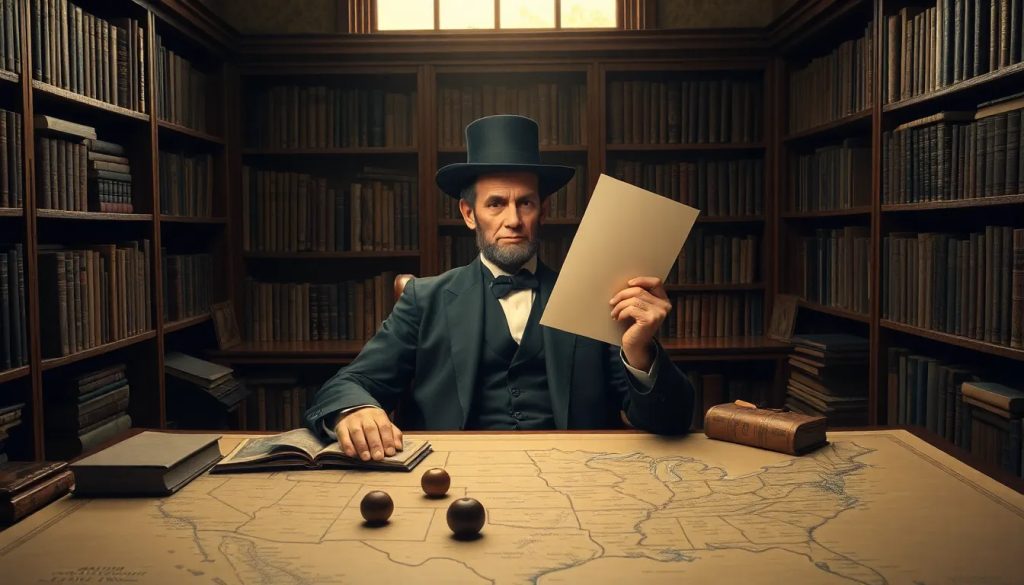
The figure of Abraham Lincoln has long attracted great interest not only for his role as president during the American Civil War, but also for his influence on education and mathematical knowledge in his time. One mathematical concept associated with his life is the rule of three, a method that, although simple, has had a significant impact in various contexts throughout history.
This article explores the history behind the rule of three, its importance in Lincoln’s education, and how this mathematical method has been viewed as both useful and problematic in modern contexts.
What Is the Story Behind the Rule of Three?
The rule of three is a basic principle of proportionality that has been used for centuries. Its origins date back to ancient times, when it was used in civilizations such as Egypt and Greece. This method makes it possible to solve proportionality problems simply and quickly.
Historically, the rule of three was formalized through the work of mathematicians such as John Napier, who introduced concepts that made it easier to understand. This development can be seen in the evolution of mathematical tools such as Napier’s bones, which helped people perform complex calculations at the time.
In education, the rule of three was taught in many schools and was considered an essential skill for trade and everyday life. As education became more widely accessible, this method became a fundamental part of mathematics instruction.
How Did Abraham Lincoln Influence Mathematics Education?
Despite his limited formal education, Abraham Lincoln showed a notable interest in learning mathematics. The rule of three was one of the mathematical tools that helped him understand concepts of proportionality relevant to his daily life and political career.
During his youth, Lincoln attended a school where mathematics was part of the curriculum, though it was not taught in a formalized way. His curiosity led him to study on his own, and he mastered several basic mathematical concepts. This shows that even in a context of frontier education, a desire to learn can overcome the limitations of the educational environment.
Lincoln also used the rule of three in practical situations, such as calculating distances and in his work as a lawyer, where mathematical precision was crucial. His appreciation for mathematics is a testament to his self-taught nature and commitment to lifelong learning.
How Important Was the Rule of Three in Lincoln’s Time?
The historical importance of the rule of three lies in its practical applications in everyday life. In Lincoln’s time, this method was widely used in trade, agriculture, and engineering. The ability to make quick and accurate calculations was essential to the growing U.S. economy.
- In agriculture, farmers used the rule of three to calculate yields and plan harvests.
- In commerce, merchants relied on it to determine prices and discounts.
- Engineers and architects used it to solve design and construction problems.
The rule of three also made mathematical education more accessible, allowing people without formal training to perform basic calculations needed in their professional lives. This democratized knowledge and encouraged self-directed learning, something Lincoln embodied in his own life.
Where Was the Rule of Three Used in Different Cultures?
The rule of three has been a universal mathematical concept, used in diverse cultures throughout history. In ancient Egypt, for example, it was used to solve construction and agricultural problems. The Egyptians had advanced knowledge of geometry that enabled them to apply the rule of three when planning their monuments.
In ancient Greece, mathematicians such as Euclid and Pythagoras explored concepts of proportionality related to the rule of three. Their work laid the foundations for the development of mathematics as we know it today.
In Chinese culture, the rule of three was also used to solve arithmetic problems and was part of the school curriculum for centuries. The rule of three thus became an essential tool in teaching mathematics across many civilizations.
What Criticisms of the Rule of Three Have Emerged in Modern Contexts?
Despite its usefulness, the rule of three has its critics. In modern contexts, some educators argue that it can be problematic, especially in non-linear mathematical situations. Criticisms like these have emerged as part of the debate over how mathematics is taught, raising questions about whether traditional methods are enough to prepare students for the challenges of modern mathematics.
One concern is that the rule of three can encourage a mechanical approach that does not always teach students to understand the reasoning behind problems. This lack of understanding can lead to errors in situations where proportionality does not apply directly.
There are also concerns about relying too heavily on simplistic methods instead of encouraging critical and analytical thinking. Modern education seeks to balance practical methods with a deeper understanding of mathematical concepts.
How Was the Rule of Three Taught During Lincoln’s Youth?
During Abraham Lincoln’s youth, the teaching of the rule of three was quite practical. The schools he attended, though limited in resources, offered basic mathematics instruction, focusing on techniques that could be used immediately in everyday life.
Lincoln learned to apply the rule of three through practical examples, which helped him understand its usefulness. Learning to solve problems effectively was essential for him, as it helped him manage everyday situations as well as his career as a lawyer.
Teaching methods at the time relied more on oral instruction and repetition, allowing Lincoln to internalize mathematical concepts through continuous practice. This shows that even in a limited educational setting, a desire to learn can lead to meaningful understanding.
Related Questions About Abraham Lincoln and the Rule of Three
Who Discovered the Rule of 3?
The rule of three has no single discoverer, as it is a mathematical principle that evolved across different cultures and eras. However, its formalization is attributed to ancient mathematicians who explored proportionality. Throughout history, it has been adapted and used by great thinkers such as John Napier, who made it easier to understand by introducing mathematical tools.
What Was Abraham Lincoln’s Famous Quote?
One of Abraham Lincoln’s most famous quotes is: “The best way to predict the future is to create it.” The quote reflects his proactive approach to challenges and his desire to take charge of his destiny, which can also be linked to his self-directed study of mathematics.
What Did Abraham Lincoln Say About the 13th Amendment?
Lincoln was a passionate supporter of the 13th Amendment, which abolished slavery in the United States. In his speeches, he emphasized the importance of freedom and equality, concepts at the heart of his policies and legacy. This demonstrates his commitment not only to social justice, but also to education and progress.
What Did Abraham Lincoln Propose?
During his presidency, Abraham Lincoln proposed a series of significant policies and reforms, including the Emancipation Proclamation, which freed enslaved people in the rebellious states. His focus was on unity and equality, reflecting his desire to build a better future for all Americans.