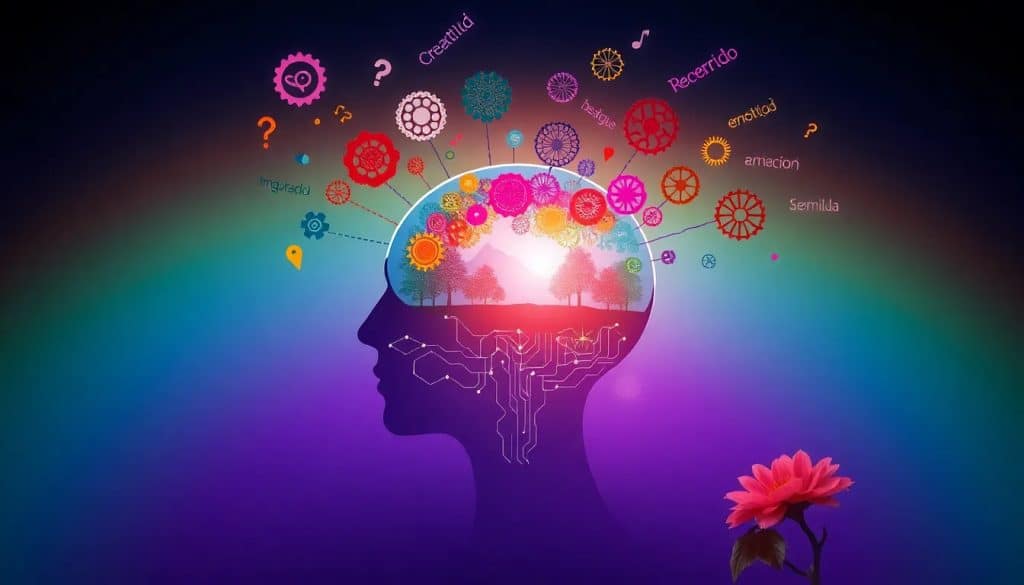
The formation of thoughts is a complex process involving different aspects of our minds and brains. Throughout this article, we’ll explore how thoughts form from the perspectives of various disciplines, such as neuroscience and psychology, and how they relate to practices like yoga and meditation.
Understanding how thoughts form gives us a better perspective on our emotions, decisions, and how we interact with the world. Below, we’ll examine the different origins of thoughts and the processes involved in their formation.
Where Do Thoughts Come From?
Thoughts arise from an intricate process involving multiple systems in our brain. They are often considered the result of neural interactions that generate ideas, reflections, and associations. These processes can be both conscious and unconscious.
One key source of thoughts is our past experiences, which are stored in memory and activated at specific moments. So, when we face similar situations, our minds tend to draw on these memories to help us make decisions.
- Past experiences: Shape perception and understanding.
- Emotions: Influence how we interpret events.
- Social interactions: our surroundings can trigger certain thoughts.
Language also plays a crucial role in the development of thoughts. It not only allows us to communicate, but also shapes how we think and organize our ideas. This means that language is not just a means of communication, but also a generator of thoughts.
The Origin of Thoughts According to Neuroscience
From a neuroscience perspective, thoughts are the product of electrical and chemical activity in the brain. Neurons communicate with one another through synapses, allowing information to be transmitted and complex neural networks to form.
Neuroplasticity is a fundamental concept that explains how the brain can reorganize itself and adapt to new experiences. This phenomenon allows our thoughts to evolve and change over time. In this way, neuroscience helps us understand how thoughts are formed and how our experiences can shape them.
Studies have also shown that different areas of the brain are responsible for different types of thinking. For example, the frontal lobe is linked to reasoning and decision-making, while the limbic system is associated with emotions and impulses.
Psychology and the Formation of Thoughts
Psychology, in turn, focuses on how our thoughts affect our behavior. Cognitive approaches suggest that thoughts result from mental processes that can be changed through therapy and self-reflection.
Beliefs and psychological conditioning play an important role in the formation of thoughts. These beliefs can be limiting or empowering, influencing how we see the world and face challenges.
- Limiting beliefs: can hinder personal growth.
- Empowering beliefs: foster self-confidence and resilience.
Emotional regulation is also an essential part of this process. Intense emotions can influence our thoughts, sometimes distorting our perception of reality. For this reason, learning to manage our emotions is crucial to fostering clearer, more positive thinking.
Where Do Thoughts Come From According to Yoga and Hinduism?
In the context of yoga and Hinduism, thoughts are considered a natural part of human existence, but also something that can be controlled. According to these beliefs, thoughts arise from the mind, which is distinct from the physical brain.
Meditation is presented as a powerful tool for observing and understanding the origins of thoughts. Practicing meditation helps develop awareness of one’s own thoughts, allowing people to step back from them and observe them without judgment.
In addition, yoga emphasizes the importance of the mind-body connection. Through physical and meditative practices, the aim is to achieve a state of calm that encourages clearer, calmer thinking.
Buddhism: Emptiness and Dependent Arising
In Buddhism, all phenomena, including thoughts, are said to arise in dependence on multiple factors. This concept, known as “dependent arising,” suggests that nothing exists in isolation, but rather in relation to its surroundings.
Emptiness, another key Buddhist concept, means that thoughts have no intrinsic existence. Rather than being fixed entities, thoughts are fluid and constantly changing, helping us understand that we can shape our mental experience.
This view encourages practitioners to let go of fixed thoughts and adopt a more flexible perspective. Doing so opens up the possibility of transforming how we perceive and respond to reality.
Meditation and Mindfulness: Observing the Origins of Thoughts
Meditation and mindfulness have become popular as effective ways to develop greater awareness of our thoughts. These practices teach us to observe our thoughts without identifying with them, promoting greater mental clarity.
By observing our thoughts from a place of calm, we can identify recurring patterns and tendencies that may influence our emotions and behavior. This gives us the opportunity to redefine our relationship with our thoughts.
- Developing attention: helps us identify and observe thoughts.
- Reducing stress: creates a clearer mental space.
- Emotional transformation: helps us manage emotions effectively.
The Neurophysiology of Meditation: How the Brain Changes
The neurophysiology of meditation has revealed that regular practice can alter the structure of the brain. Studies have shown that meditation can increase the thickness of certain brain areas associated with attention and self-regulation.
In addition, meditation changes brain activity, promoting the activation of areas associated with calm and happiness. This shows how the practice can influence the formation of more positive and constructive thoughts.
Through meditation, new neural connections can develop to support a healthier approach to thoughts and emotions. This change leads to greater serenity and resilience in the face of life's challenges.
Related Questions About How Thoughts Form
How are thoughts formed in the mind?
Thoughts are formed in the mind through the interaction of cognitive processes, including perception, memory, and attention. These processes work together to generate ideas, reflections, and analysis.
The mind is also influenced by past experiences and emotions, making each thought unique and shaped by its context. Thus, the formation of thoughts is a dynamic process, which can be shaped by new experiences and learning.
How are thoughts generated in the mind?
Thoughts are generated from information we receive from our surroundings and from our inner experiences. The mind processes this information through neural networks, creating connections that give rise to new thoughts.
This process can be both conscious and unconscious; for example, thoughts often arise without us being fully aware of where they come from. Self-observation and reflection can help us identify these patterns.
How should our thoughts be formed?
Our thoughts should be formed in ways that support mental health and well-being. This involves cultivating critical and reflective thinking that values both emotions and logic.
Emotional regulation plays a crucial role in this process. Learning to regulate our emotions helps us form more balanced and realistic thoughts. By developing a positive mindset, we can influence our actions and decisions constructively.
What are the 4 types of thinking?
The four most relevant types of thinking are:
- Critical thinking: objective, reasoned analysis of situations.
- Creative thinking: generating innovative ideas and original solutions.
- Reflective thinking: deep contemplation of experiences and learning.
- Positive thinking: focusing on the optimistic and constructive, which promotes well-being.
Understanding and developing these types of thinking can enrich our daily lives and improve the quality of our decisions. In summary, the formation of thoughts is a dynamic process that draws on experiences, emotions, and reflection, and can be changed and improved over time.