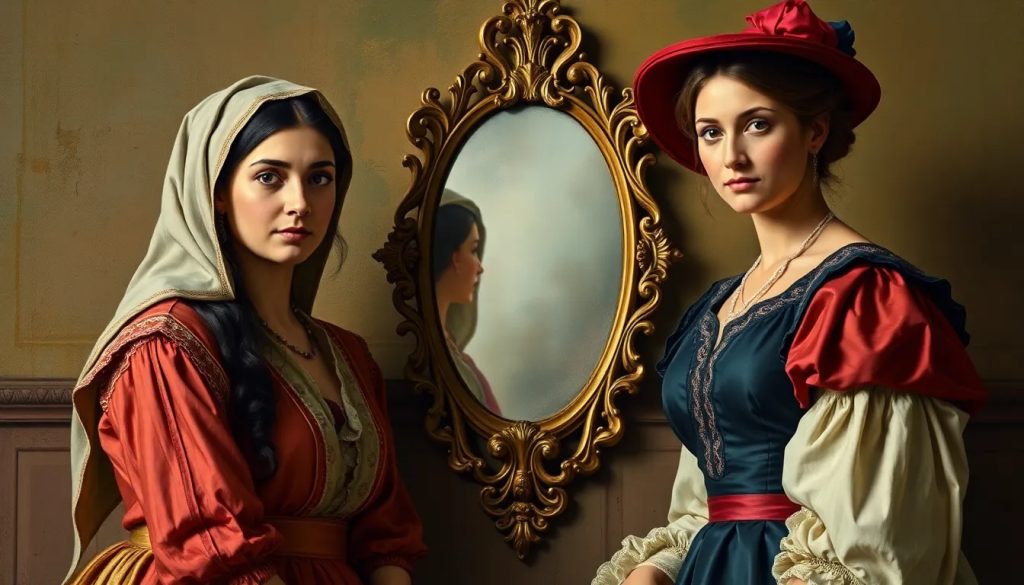
Benito Pérez Galdós’s novel “Fortunata y Jacinta” is a clear reflection of the social and moral tensions in 19th-century Spain. Through a complex love triangle, Galdós exposes the hypocrisy of a society clinging to appearances and traditional values. This analysis will focus on how Galdós portrayed society’s hypocrisy in ‘Fortunata y Jacinta’.
In this novel, Galdós tells not only a love story but also explores themes such as female independence, morality, and the social structures of his time. The author creates characters who embody society’s contradictions, showing how an obsession with maintaining appearances can destroy lives and dreams.
How does the love triangle unfold in Fortunata y Jacinta?
The love triangle in “Fortunata y Jacinta” is one of the central elements that allows Galdós to explore social hypocrisy. It involves Fortunata, a woman from a humble background, and Jacinta, a woman from the upper class, both of whom are in love with Maximiliano, a man caught between his desires and his sense of duty.
The relationship between these three characters portrays not only love but also the inequality and sexism present in society at the time. Fortunata represents a woman fighting for her independence, while Jacinta symbolizes conformity and acceptance of social norms, even when they are oppressive.
Fortunata’s struggle to be valued for more than her social status becomes a critique of a hypocritical system that judges people by their status rather than their character. Galdós uses this love triangle to show how Maximiliano’s decisions, influenced by social pressure, affect both women in devastating ways.
Who are the main characters in Fortunata y Jacinta?
- Fortunata: Represents the struggle for freedom and personal autonomy.
- Jacinta: Embodies the morality and hypocrisy of high society.
- Maximiliano: A man divided between two worlds, reflecting the ambiguity of his desires.
Each of these characters offers a different perspective on love and social relationships. With her passionate nature and desire to be genuinely loved, Fortunata challenges social conventions. Jacinta, on the other hand, despite her privileged position, is trapped in a marriage that does not fulfill her emotionally.
Maximiliano, for his part, epitomizes the man who, despite his selfishness, is forced to navigate society’s expectations and his own desires. The complexity of these characters and their interactions reveals the deep contradictions of life in 19th-century Madrid.
What social issues are explored in Fortunata y Jacinta?
“Fortunata y Jacinta” explores various social issues, such as social hypocrisy, sexism, and the struggle for female identity. Through its characters, Galdós criticizes how social norms restrict individual freedom and perpetuate inequality.
- Women's financial dependence on men.
- The moral double standard in society, which condemns women for actions men can take without facing any consequences.
- The search for personal identity in a world that values appearances more than authenticity.
Sexism is evident in the way men, such as Maximiliano, make decisions that affect women without considering their wishes or feelings. Galdós also shows how women try to resist these limitations and find their own path, which brings them into conflict with established norms.
How Are Women Portrayed in Fortunata y Jacinta?
The women in “Fortunata y Jacinta” are portrayed as multidimensional characters. Fortunata represents the feminist struggle and the search for a voice of her own, while Jacinta, despite her privileged position, also suffers the consequences of a patriarchal system. Despite their differences, both women are caught in a web of social expectations that limit their freedom.
Galdós uses these female characters to explore the different ways people resist or conform to society. Despite her circumstances, Fortunata seeks happiness and independence, while Jacinta clings to her status despite her unhappiness. This portrayal of women highlights the importance of their role in the social criticism Galdós develops in the novel.
What Role Does Hypocrisy Play in Fortunata y Jacinta?
Hypocrisy is a central theme in “Fortunata y Jacinta”. Galdós shows how appearances can be deceptive and how the characters' actions often contradict their words and values. Society at the time is full of unquestioned conventions, leading to absurd and tragic situations.
Through characters such as Jacinta, Galdós shows the conflict between traditional morality and the reality of human emotions. Despite her seemingly perfect appearance, Jacinta leads a life of dissatisfaction and deception. Fortunata, on the other hand, is seen as a woman of low social standing, yet embodies values of authenticity and passion that society rejects.
What Message Does Galdós Convey Through the Ending of Fortunata y Jacinta?
The ending of “Fortunata y Jacinta” is both tragic and revealing. Galdós leaves readers reflecting on the human condition and the limitations imposed by society. The resolution of the plot lays bare the consequences of selfishness and hypocrisy, showing how the characters are unable to escape their own destinies.
Galdós's message can be interpreted as a critique of a society that prioritizes appearances over authenticity. Through Fortunata's suffering, the author highlights the need for social and personal transformation, inviting readers to question the norms that govern their lives.
What Influence Has Fortunata y Jacinta Had on Spanish Literature?
“Fortunata y Jacinta” is considered one of the masterpieces of Spanish realism and has had a profound influence on later literature. Through his meticulous style and ability to portray the complexity of human life, Galdós has left an indelible mark on Spanish fiction.
The novel has been the subject of numerous analyses and studies, becoming a touchstone for understanding the social and cultural dynamics of its time. Galdós not only made a significant contribution to literature, but also opened up space for discussion of topics such as female identity, social hypocrisy, and criticism of the patriarchal system.
Related Questions About Fortunata y Jacinta
What Is the Plot of Fortunata y Jacinta?
The plot of “Fortunata y Jacinta” centers on the love triangle between Fortunata, a woman from a lower social class; Jacinta, who is upper-class; and Maximiliano, a man torn between his desires and his obligations. Through their interactions, Galdós illustrates the social tensions and hypocrisy of the time. The novel is a critique of society's morality, showing how love and duty can clash in heartbreaking ways.
What Is the Main Theme of Fortunata y Jacinta?
The main theme of “Fortunata y Jacinta” is social hypocrisy and the struggle for female identity. Galdós explores how women face a system that limits their aspirations and desires, portraying the complexity of their lives and relationships. The novel also addresses themes such as sexism and emotional dependence, reflecting the reality for many women of the time.
What Was Benito Pérez Galdós's Ideology?
Benito Pérez Galdós identified with realism and naturalism, seeking to portray society as it is, with both its virtues and its flaws. His work reflects a critical outlook that questions social norms and advocates for a greater understanding of the human condition. Galdós was deeply interested in the social issues of his time, and his writing often incorporates elements of compassion and social justice.
What Happens in Fortunata y Jacinta?
In “Fortunata y Jacinta”, the plot unfolds through the interactions between the three main characters, revealing their desires, frustrations, and struggle for true love. Fortunata seeks recognition and appreciation, while Jacinta tries to maintain her status in a society that does not satisfy her. As the story progresses, the hypocrisies and contradictions affecting each of them come to light, leading to a tragic and thought-provoking conclusion.