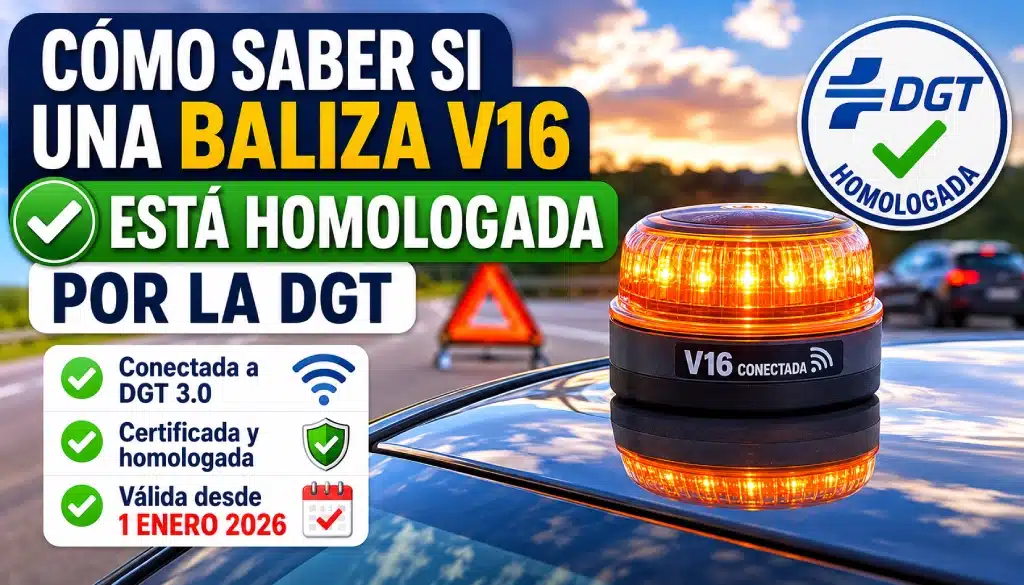
Knowing whether a V16 emergency beacon is approved by the DGT has been essential since 1 January 2026. From that date, just any emergency warning light will not do: it must be a connected V16 emergency beacon, certified and included on the official list of the Directorate-General for Traffic.
This guide explains in simple terms how to check whether your V16 emergency beacon is valid, what information to check before buying one, and which mistakes to avoid so you do not end up with a device that is not legally compliant. You can also find more information in our guide on when it is mandatory to use the emergency warning light.
Quick summary
To find out whether a V16 emergency beacon is approved, check three things: that it is connected, that it appears on the DGT’s official list of certified models, and that the device or its cover displays the certification laboratory and report number. If it is not on the official list, you should not buy it.
What Is a DGT-Approved V16 Emergency Beacon?
A DGT-approved V16 emergency beacon is a light-emitting hazard warning device that meets the technical requirements set out in Spanish regulations. It is used to warn other road users when a vehicle has been immobilised because of a breakdown, an accident, or a load falling onto the road.
The key difference since 2026 is that a valid beacon must be a connected V16. This means that when activated, it not only emits a visible light but also sends the location of the stationary vehicle to the DGT 3.0 connected vehicle platform.
It is not enough for the packaging to say “approved” or “compatible with the DGT.” The important check is whether the model appears on the DGT’s official list.
How to Check Whether Your V16 Emergency Beacon Is DGT-Approved
The most reliable way to check a V16 emergency beacon is to consult the official source. The DGT publishes an up-to-date list of certified brands and models. It is a good idea to check this list before buying a beacon or if you already own one.
- Go to the DGT’s official page on V16 devices.
- Look for the section on certified brands and models.
- Find the brand and exact model of your beacon.
- Check the certificate number.
- Make sure the certificate is not listed as expired or no longer valid.
You can check the official list on the DGT page about V16 warning devices.
What information must a valid V16 beacon display?
A beacon must do more than emit light to be valid. From 2026, it must meet a set of technical and administrative requirements.
| What to check | Meaning | Why it matters |
|---|---|---|
| Exact model | Commercial name of the device | Must match the official list |
| Brand | Manufacturer or brand | Helps identify the actual product |
| Certificate number | Test or certification reference | Allows you to check that it has been certified |
| Laboratory | IDIADA or LCOE, among other designated laboratories | The DGT requires valid certification |
| Connectivity | Communication with DGT 3.0 | Mandatory from 2026 |
| Connectivity expiry date | How long the included service works | Must be shown on the packaging and device |
Where to find the approval number
The DGT says certified beacons must display a mark consisting of the name of the testing laboratory and the report number. This information is usually found on the dome of the device, on the beacon itself or in its documentation.
When buying one, check the packaging too. If the product does not clearly show the model, certification, included connectivity and service expiry date, it is best to be cautious.
Be careful
Some beacons are sold as “V16”, “emergency light” or “DGT-compatible”, but that does not guarantee they will be valid from 1 January 2026. What matters is that they are connected and appear on the DGT’s official list.
Difference between standard and connected V16 beacons
For a while, different types of devices have been used: warning triangles, non-connected V16 beacons and connected V16 beacons. But from 1 January 2026, only a connected V16 beacon is valid as a legal way to signal immobilised vehicles in Spain.
| Type of signal | Is it valid from 2026? | Comment |
|---|---|---|
| Warning triangles | Not as the primary system in Spain | Replaced by the connected V16 beacon |
| Non-connected V16 beacon | No | It can emit light, but does not communicate with DGT 3.0 |
| Connected and certified V16 beacon | Yes | Must appear on the official list |
Does a V16 beacon track your location all the time?
One of the most common questions is whether a connected V16 beacon can track the driver. According to official information from the DGT and the Spanish Data Protection Agency, the beacon only transmits information when activated in an emergency.
Furthermore, the information sent is not linked to a person or a vehicle registration number. Its purpose is to report the location of the immobilised vehicle to improve road safety—not to reconstruct journeys or identify the driver.
If you have concerns about privacy, scams or fake messages, you may also find our guide to internet dangers and how to prevent them useful.
Does it need an app or a monthly subscription?
An approved connected V16 beacon should not require you to download an app to use it or connect your phone in an emergency. Connectivity must be built into the device itself.
The DGT also says that the law requires connectivity to be available for at least 12 years, with the cost included in the purchase price. That is why it is important to check the service expiry date shown on the packaging and the beacon itself.
Common mistakes when buying a V16 emergency warning beacon
If you're buying a V16 emergency warning beacon, avoid these mistakes:
- Choosing based on price alone without checking the official list.
- Assuming that any V16 light will be valid from 2026.
- Failing to check whether it connects to DGT 3.0.
- Not checking the exact model and certificate number.
- Trusting advertisements that claim a beacon is “certified” without providing verifiable details.
- Buying an old, non-connected beacon and assuming it is still valid.
Practical tip
Before buying, look up the model on the DGT's official website. If it isn't listed, choose another one. It's better to take a minute to check than to buy a beacon you can't legally use.
How to use a V16 emergency warning beacon correctly
In the event of a breakdown or accident, the V16 beacon is designed to save you from having to walk along the road to put out warning triangles. It's easy to use:
- Stop your vehicle in the safest place possible.
- Turn on your car's hazard lights.
- Take the beacon from inside the vehicle, if you can do so safely.
- Switch it on and, preferably, place it on the roof of the vehicle.
- Stay in a safe place and contact roadside assistance or emergency services if necessary.
For more vehicle-related tips, you can also read our guide on how to find your car's paint colour code or our article about medications that can affect driving in Spain.
Frequently asked questions about certified V16 beacons
▸ How can I tell if my V16 beacon is certified?
Check that the exact model is included in the DGT's official list of certified brands and models. Also check that the certification laboratory and relevant report number are provided.
▸ Is a non-connected V16 beacon valid?
No. From 1 January 2026, a valid beacon in Spain must be connected and certified. Non-connected V16 beacons are no longer valid as the sole legal means of signalling immobilised vehicles.
▸ Where can I find the official list of V16 beacons?
The official list is on the DGT page dedicated to V16 advance warning devices. It includes the valid brands, models and certificates.
▸ Does the V16 beacon track me while I drive?
No. The beacon only transmits information when activated in an emergency. It does not send data continuously or link to a person or vehicle registration number.
▸ Is there a fee for connectivity?
There should be no monthly fee for the user. At least 12 years of connectivity must be included in the purchase price of the device, although it's worth checking the service expiry date.
Conclusion
To find out whether a V16 beacon is certified by the DGT, don't rely solely on the packaging or an advertisement. Always check that the model is on the DGT's official list, that it is a connected V16 beacon and that it displays the relevant certification details.
From 1 January 2026, the connected V16 beacon is the legal system for signalling immobilised vehicles in Spain. Buying the right beacon doesn't just help you avoid legal problems; it also improves your safety if you break down or have an accident on the road.
Recommended Official Sources