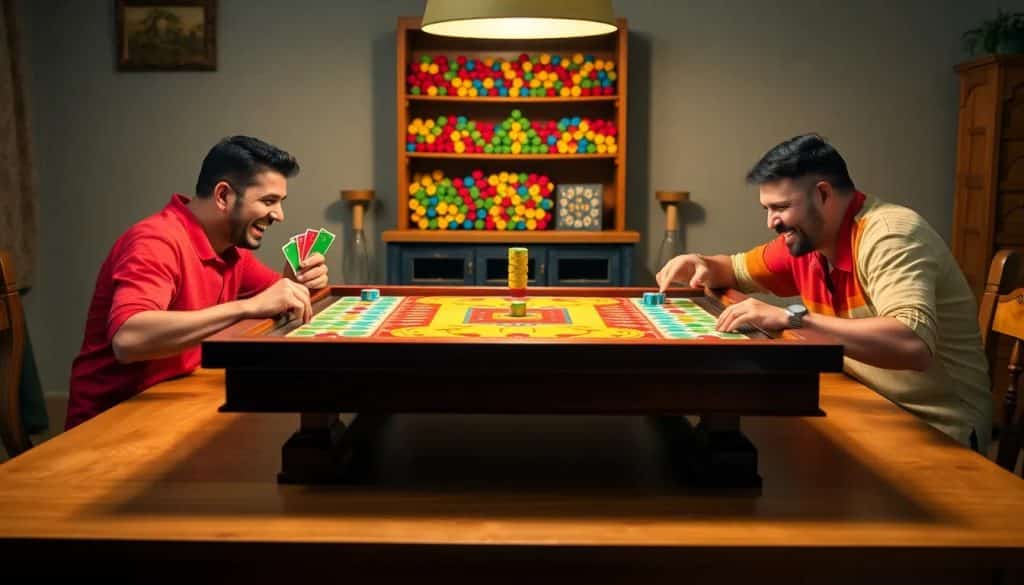
Pachisi is a traditional board game that has stood the test of time in India and Pakistan. Its cross-shaped design allows up to four players to take part in exciting games. Players aim to move their pieces to “home,” becoming the first to complete the course.
This game, played with dice or cowrie shells, offers entertainment and strategy while encouraging family interaction. Below, we’ll explore the rules, history, and various versions that have evolved from Pachisi.
How Do You Play Pachisi?
Pachisi is played on a board with a specific design that lets players move their pieces toward the finish. Each player starts with four pieces at “home.” Two dice determine how far they move. Here’s a brief overview of the Pachisi rules for beginners:
- Each player rolls the dice to determine who goes first.
- A roll of five or more is needed to move a piece out of “home.”
- Players move their pieces forward by the number of spaces shown on the dice.
- If a player lands on a space occupied by an opponent’s piece, they can “capture” it, sending it back home.
- The first player to move all their pieces to “home” wins.
Pachisi also involves strategies such as forming blockades or protecting pieces, which adds complexity to the game. It’s a fun way to play with the family and develop critical-thinking skills.
What Is the History of Pachisi?
Pachisi has roots that go back centuries in India. It is said to have been created during the reign of Emperor Akbar in the 16th century, who used a giant board to play with actors. Its popularity spread, and it became a symbol of Indian culture.
The name “Pachisi” comes from the Hindi word “paccīs,” meaning twenty-five, the highest score possible with the dice. Over time, Pachisi gave rise to other variants, such as Parchís in Spain and Parqués in Colombia, which share the same essence but have adapted rules.
Pachisi has had a profound influence on Indian culture and society. It has been played at family gatherings and festivals, helping foster social cohesion and provide entertainment. Pachisi is therefore not just a game, but also a cultural legacy.
Is Pachisi the Same as Parchís?
Although Pachisi and Parchís are similar, they are not exactly the same. Parchís is a Spanish adaptation of Pachisi. Both games use a cross-shaped board and can be played by up to four players, but their rules and gameplay differ.
For example, in Parchís, players can “capture” an opponent’s piece by landing on an occupied space, while Pachisi uses the dice in more varied and strategic ways. Despite these differences, both games reflect the essence of the original Pachisi.
- Pachisi is the original game, while Parchís is a Spanish variant.
- Both games can be played by two to four players.
- The rules for “capturing” pieces and forming “blocks” can vary between the two.
This demonstrates the rich history of board games and their ability to adapt to different cultures.
10 rules of Parchís
Although Parchís is an adaptation of Pachisi, many of the rules are similar. Here is a list of 10 rules of Parchís that can help you better understand this popular game:
- To decide who goes first, each player rolls a die; the player who rolls the highest number starts the game.
- You need to roll a 5 to move a piece out of “home.”
- Players move their pieces according to the number rolled on the die.
- If a piece lands on a space occupied by an opponent, it “captures” that piece.
- You can block other players by placing two pieces on the same space.
- Pieces must reach the finish with an exact roll of the die.
- The first player to move all their pieces to “home” wins.
- If a player rolls doubles, they can roll again.
- Pieces can move in the opposite direction if they are blocked.
- It’s a game that encourages strategy and social interaction.
These rules are just a starting point for enjoying Parchís, which, like Pachisi, can be played with family and friends for hours of fun.
Types of Board Games
Pachisi is just one of the many types of board games played around the world. There’s a wide variety of games offering different playing experiences. Here are a few examples:
- Strategy games: Games that require planning and tactics, such as chess.
- Games of chance: Games where luck plays an important role, such as dice games or Monopoly.
- Card games: Such as poker or bridge, which require skill and strategy.
- Cooperative games: Games where players work together to achieve a common goal.
Each type of game offers a unique experience, encouraging both competition and collaboration among players. As a game of strategy and chance, Pachisi combines both elements.
History of Board Games
The history of board games dates back thousands of years, with evidence of their existence in ancient civilizations. From the game of Senet in Egypt to Go in China, board games have served as a form of entertainment and education.
Pachisi is part of this rich historical tradition. In India, it has been used not only for entertainment but also as a way to develop cognitive and social skills. It has brought families together across generations, reflecting cultural and social values.
Board games such as Pachisi continue to evolve and adapt, remaining relevant in the modern era, where technology competes for the public’s attention.
Parchís for Blind Players
Parchís, like Pachisi, can be adapted for blind players. This is essential to ensure that everyone can enjoy these games. Specially designed boards use textures and contrasting colors to make it easier to identify the spaces.
Specific rules can also be developed to help players understand the game without needing to see the board. These adaptations include:
- Using tactile pieces to distinguish between colors and shapes.
- Braille instructions on the board.
- Assistants who can guide players during the game.
These adaptations make Pachisi and its variant, Parchís, inclusive and accessible to everyone, promoting enjoyment and social interaction.
Frequently Asked Questions About Pachisi and Its History
How Do You Play Pachisi?
Pachisi is played on a board where players move their pieces toward the finish. Each player uses two dice to determine how far to move. Players must roll a specific score to move their pieces out of “home” and advance. They can also “capture” other players’ pieces by landing on a space they occupy. This adds a strategic element to the game.
Is Pachisi the Same as Ludo?
No, Pachisi is not the same as Ludo. Although both have a similar board design and can be played by up to four people, their mechanics and rules are different. Ludo is a simplified version derived from Pachisi, so although the games are related, they are not identical.
What is the history of Pachisi?
Pachisi has a rich history dating back to 16th-century India, during the reign of Emperor Akbar. The game was used not only for entertainment but also as a way to display power and status. It has influenced various board game variants around the world, creating a cultural legacy that lives on to this day.
Is Pachisi the same as Parchís?
No. Although they are related, Pachisi and Parchís are different games. Pachisi is the original game from India, while Parchís is a simplified variant popular in Spain and Latin America. They share some features, but have different rules and gameplay.