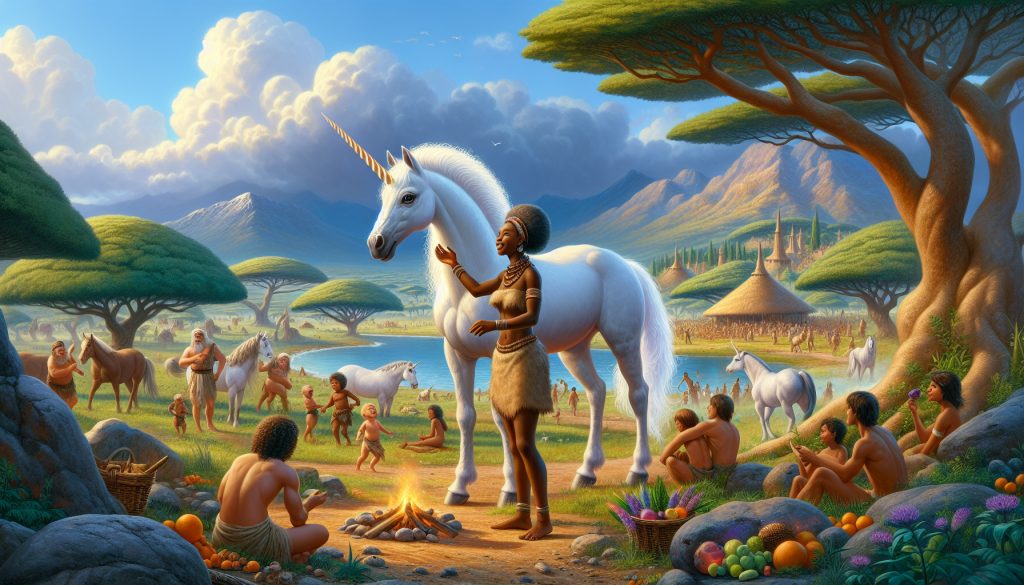
The unicorn has fascinated humanity for centuries, serving as a symbol of purity and beauty. However, recent discoveries suggest that unicorns coexisted with humans, challenging our understanding of prehistory and the wildlife of the time. In this article, we explore the reality behind these mythical creatures and their connection to our ancestors.
Did Unicorns Really Exist Alongside Humans?
The existence of unicorns has been debated for years. The answer may be more complex than it seems. Recent research indicates that the Siberian unicorn, known as Elasmotherium sibiricum, may have shared a habitat with humans around 29.000 years ago.
This rhinoceros, which could weigh up to four tonnes, had a prominent horn on its head, similar to the mythical depiction of a unicorn. It is therefore plausible that legends about unicorns were based on encounters with this real species.
Using radiocarbon dating, scientists have dated remains of Elasmotherium sibiricum, revealing that the species existed at the same time as humans. This has raised questions about the role these mammals played in the culture and mythology of prehistoric communities.
What Were Unicorns Originally Called?
The name used for the unicorn has evolved over time. In the case of Elasmotherium sibiricum, its name refers to its habitat and physical characteristics. “Elasmo” comes from a Greek word meaning “flat,” referring to its distinctive morphology.
It is interesting to note how perceptions of unicorns have changed. In ancient times, they were often known as “one-horned beasts,” highlighting the connection between legends and the real rhinoceroses of the time. Over time, the term “unicorn” has become more closely associated with fantasy and mythology.
In this way, the understanding of the unicorn has transformed, from a real creature into a symbol imbued with cultural and spiritual meaning in various civilizations.
Where Did Unicorns Live Before They Went Extinct?
The habitat of Elasmotherium sibiricum covered vast regions, mainly what is now Kazakhstan and parts of Siberia. These rhinoceroses lived in grasslands and steppes, where they could find enough food and space to roam.
- Open grasslands
- Dry steppes
- Areas with dense vegetation
Its extinction, once thought to have occurred more than 350.000 years ago, has been reassessed in light of new findings. The discovery of well-preserved remains in Kazakhstan suggests these animals may have survived much longer than previously believed, coexisting with human communities that were already beginning to settle in those regions.
Research into its habitat provides valuable information about the climate and living conditions in prehistory, and also helps us understand how humans interacted with these large creatures.
What Is the Siberian Unicorn, and Why Is It Important?
The Siberian unicorn, known scientifically as Elasmotherium sibiricum, is one of the most fascinating species to capture the imagination of scientists and popular culture. This prehistoric mammal, with its imposing horn, is considered a key species for understanding Pleistocene wildlife.
Its size, comparable to that of a modern rhinoceros, and its ability to adapt to different environments make it an interesting subject of study. Scientists have sought to understand its diet and behaviour, and how these aspects relate to humans of the time.
Furthermore, Elasmotherium sibiricum is relevant not only to understanding how humans and animals coexisted, but also to assessing how ecosystems have changed throughout history. Discoveries about this Siberian unicorn challenge existing ideas about extinction and survival in prehistory.
What Are the Characteristics of Elasmotherium sibiricum?
Elasmotherium sibiricum stands out for its unique physical characteristics. Here are some of its main features:
- Impressive size: It could weigh up to four tonnes.
- Prominent horn: Its horn, which could measure up to 1.5 metres, made it resemble the mythical unicorn.
- Dietary adaptations: As a herbivore, it adapted to different types of vegetation, from grasses to shrubs.
The characteristics of Elasmotherium sibiricum are fascinating not only from a zoological perspective, but also offer clues about its ecosystem and the role it played in interactions with humans. Its great size and strength made it a dominant species in its habitat.
These prehistoric mammals have also been depicted in various works of art and culture, reflecting their impact on the mythology and folklore of ancient civilizations that may have coexisted with them.
Why Are Recent Studies on Unicorns Significant?
Research into Elasmotherium sibiricum has gained momentum in recent years thanks to advances in dating techniques and molecular analysis. These studies have challenged earlier perceptions and opened up new ways of understanding the coexistence of humans and unicorns.
One of the most significant discoveries has been the finding of well-preserved remains in Kazakhstan, which have enabled scientists to date this species to a period close to the arrival of the first modern humans in the region.
These studies are important because they shed light not only on the natural history of unicorns, but also offer a window into how humans may have interacted with them. Understanding this dynamic can provide valuable insights into the cultural evolution of humans and their relationship with other living things.
Related Questions About Unicorns and Humans Coexisting in Prehistory
Did Unicorns Really Exist?
The existence of unicorns has been debated. However, Elasmotherium sibiricum is considered the “real unicorn” of prehistory. Finds in Kazakhstan suggest that these animals coexisted with humans much more recently than previously thought, raising new questions about how they interacted.
How Did the Unicorn Originate?
The term “unicorn” comes from the Latin “unicornis,” meaning “one horn.” Its origins are associated with descriptions of various horned animals in ancient literary and mythological works. The image of the unicorn has evolved, inspired by real creatures such as Elasmotherium sibiricum.
What Were Unicorns Originally Called?
In ancient times, unicorns were known as “one-horned beasts” or “rhinoceroses.” Over time, the unicorn figure changed, taking on magical and symbolic qualities in popular culture.
Where Did Unicorns Live?
Unicorns, represented by Elasmotherium sibiricum, lived mainly in the grasslands and steppes of Kazakhstan and Siberia. Their habitat was vast and diverse, supporting a rich array of wildlife that coexisted with humans of the time.