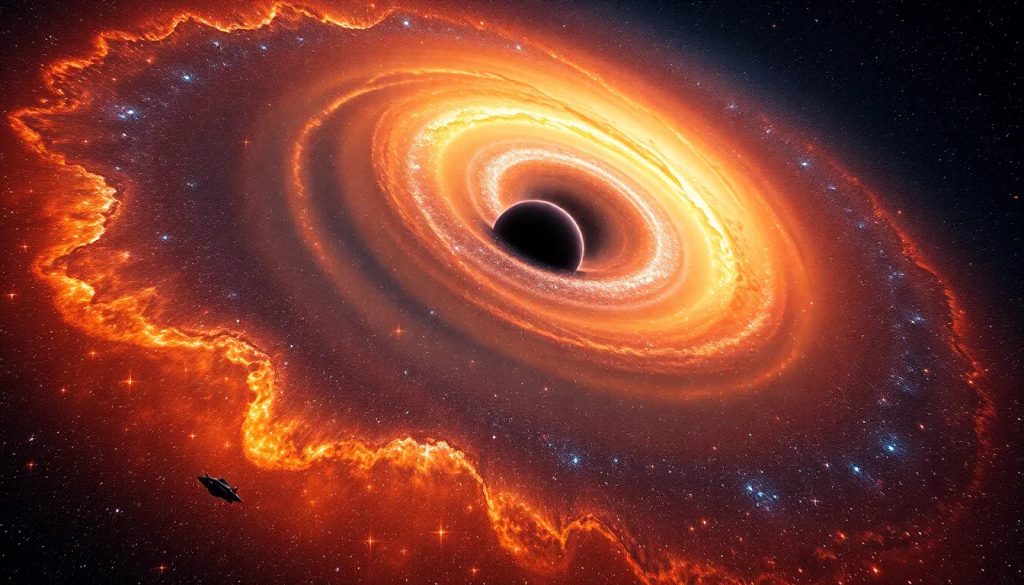
Sagittarius A* is a supermassive black hole at the heart of the Milky Way. With a mass equivalent to 4.1 million times that of the Sun, it has captured the attention of astronomers and space enthusiasts because of its mysterious nature and recent advances in its study.
In this article, we'll explore various aspects of Sagittarius A*, from its characteristics and how it formed to its impact on the galactic environment. We'll also look at the fascinating image captured of this cosmic object and its significance in modern astronomy.
Is Sagittarius A* dangerous to Earth?
People often ask whether Sagittarius A* poses a danger to Earth. However, it is essential to consider how far away it is. This black hole is about 26,000 light-years from our planet, which means its direct gravitational influence on Earth is virtually nonexistent.
It is also currently dormant. This means it is not actively “feeding” on matter, making it less threatening at this time. However, scientists continue to monitor its behavior for changes that could alter this assessment.
Black holes can influence their surroundings by their very nature. Sagittarius A*, for example, affects nearby stars, but its influence is limited to 99.9% of the matter in its area. This limits the presence of other celestial bodies in the vicinity.
What is a black hole, and how does it form?
A black hole is a region of space where gravity is so intense that nothing, not even light, can escape. Black holes form when massive stars collapse at the end of their life cycle. When a star runs out of nuclear fuel, the internal pressure that counteracts gravity decreases, causing the star to collapse in on itself.
There are different types of black holes, with supermassive black holes such as Sagittarius A* being the largest. They are generally found at the centers of galaxies and have masses millions of times greater than the Sun's.
Sagittarius A* is thought to have formed in the core of the Milky Way billions of years ago, when matter accumulated and collapsed under its own gravity.
What are the main characteristics of Sagittarius A*?
Sagittarius A* has several characteristics that make it unique compared with other black holes. These include:
- Mass: Approximately 4.1 million times the mass of the Sun.
- Location: At the center of the Milky Way, 26,000 light-years away.
- Radiation emission: Sagittarius A* emits radio waves that can be observed from Earth.
- Dormant state: It is currently inactive, although it may occasionally feed on surrounding gas.
These characteristics make it a fascinating object of study for astronomers, who are seeking to better understand the dynamics of supermassive black holes and their role in the formation and evolution of galaxies.
How does the mass of Sagittarius A* compare with the Sun’s?
Sagittarius A* has an astonishingly large mass, reaching approximately 4.1 million times that of the Sun. To put this into perspective, comparing Sagittarius A* with other black holes shows that its mass places it among the largest known.
This kind of mass is crucial to understanding how these black holes affect their surroundings. Sagittarius A*’s gravity affects nearby stars, such as the star S2, allowing scientists to measure its influence and, in turn, accurately estimate its mass.
Comparing Sagittarius A*’s mass with the Sun’s also has implications for understanding how black holes form and evolve over the course of galactic history.
How was the image of Sagittarius A* captured?
The image of Sagittarius A* was captured by the Event Horizon Telescope, an international project that brought together radio telescopes around the world. Using very long baseline interferometry (VLBI), scientists were able to obtain an image of the black hole.
This process involved synchronizing telescopes in different parts of the world so they could act as a single, planet-sized telescope. This technique made it possible to see the ring of light surrounding Sagittarius A*, providing visual evidence of its existence.
Capturing this image is a milestone in modern astronomy: it confirms Einstein’s theory of relativity and opens up new avenues for research into black holes.
What important facts are known about Sagittarius A*?
Sagittarius A* has been the subject of extensive research and has revealed several important facts:
- Radio emissions: It emits radiation detectable from Earth, allowing scientists to study its behaviour.
- Gravitational influence: It encompasses 99.9% of the matter in its area, affecting the movement of nearby stars.
- Dormant state: Although dormant, it can feed on surrounding material in its gas disk.
- Confirmation of relativity: Observations of its influence on the star S2 have corroborated Einstein’s theory.
These findings are significant not only for understanding Sagittarius A*, but also for shedding light on the behaviour of supermassive black holes in general and how they interact with their galactic surroundings.
Black holes in our galaxy: how many are there?
The Milky Way is home to many black holes, although Sagittarius A* is the best known and most studied. It is estimated that there are thousands of black holes in our galaxy, varying in size and mass.
Most of these black holes are smaller, having formed from the collapse of individual stars. Supermassive black holes like Sagittarius A*, however, are much rarer and are found at the cores of galaxies.
The existence of so many black holes raises questions about how they form and the role they play in galactic evolution. Scientists continue to investigate to better understand the relationship between these objects and the galaxies they inhabit.
Frequently Asked Questions About Sagittarius A*
What is the Sagittarius A* black hole?
Sagittarius A* is a supermassive black hole at the centre of the Milky Way. With a mass 4.1 million times that of the Sun, its existence was confirmed through direct observation by the Event Horizon Telescope. This black hole is notable for its gravitational influence on nearby stars and its ability to emit radio waves, making it an object of great interest to astronomers.
Is the Sagittarius A* black hole dangerous?
Although Sagittarius A* is a supermassive black hole, it poses no danger to Earth because it is 26,000 light-years away. It is currently dormant, meaning it is not actively absorbing material. However, scientists continue to monitor its activity for possible changes that could alter this situation.
What can you tell us about the black hole at the centre of our galaxy?
The black hole at the centre of our galaxy, known as Sagittarius A*, is a fascinating object that has been studied for decades. Its mass and unique characteristics make it essential to understanding the dynamics of the Milky Way. Observations of stars orbiting it have made it possible to confirm its existence and study its gravitational influence on the galactic surroundings.