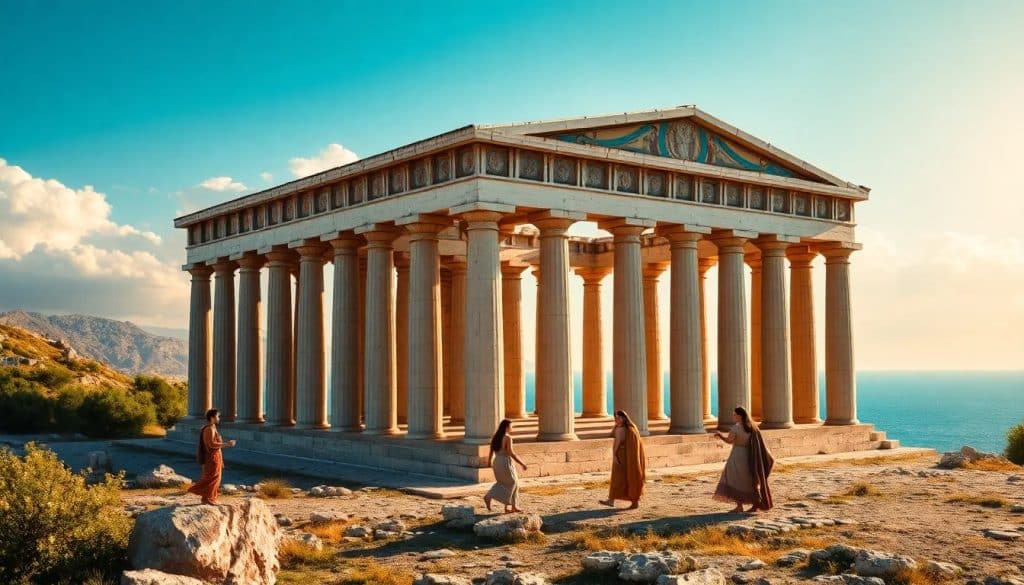
The Kingdom of Minos is one of the most fascinating narratives in Greek mythology, linked to the mythical island of Crete. This story covers not only the figure of Minos, but also the Minoan civilization, a people who left an indelible mark on ancient history.
In this article, we’ll explore the highlights of the Kingdom of Minos, from the king’s legend to his connection with the famous labyrinth and the Minotaur.
The legend of King Minos
Minos, a central figure in Greek mythology, is known as the king of Crete and is credited with creating a legal system and governing fairly. He is said to have been the son of Zeus and Europa, and his figure has been the subject of many stories and legends.
His reign was characterized by Crete’s naval supremacy, which made the island an important trading hub in the Mediterranean. However, his story also includes darker elements, such as the curse of Poseidon, which affected his family and brought personal tragedies.
In the myths, Minos is portrayed as a king who demanded tributes of young Athenians, highlighting his role as a leader who was both feared and respected. This aspect of his character makes him a complex and intriguing figure.
Who Was King Minos in Greek Mythology?
Minos is remembered not only as a king but also as an important figure in Greek mythology. He is considered a lawmaker who established just laws, although his methods were often brutal or drastic.
Legend has it that after his death, Minos became a judge of the dead in the underworld, underscoring his connection with justice and authority. This transformation reinforces his image as a leader who weighed good against evil.
His story is intertwined with those of other mythical figures, such as Daedalus, the architect of the Labyrinth, and Pasiphaë, his wife, who is famous for her connection to the Minotaur.
What Is the Story of the Minotaur and Its Connection to Minos?
The story of the Minotaur is one of the best-known tales in Greek mythology. This creature, with the body of a man and the head of a bull, was born from an encounter between Pasiphaë and a bull sent by Poseidon as part of his revenge against Minos.
To contain the Minotaur, Minos ordered the construction of the Labyrinth, a masterpiece designed by Daedalus. It was so complex that no one could escape once inside. The relationship between Minos and the Minotaur symbolizes the challenges of his reign and the consequences of divine desires.
The Minotaur also became a symbol of the struggle between humanity and its primal instincts. The story of Theseus, who killed the Minotaur, represents the triumph of reason over barbarism.
What Mysteries Does King Minos’s Labyrinth Hold?
The Labyrinth of Crete is one of the most fascinating mysteries associated with the Kingdom of Minos. Its design, attributed to Daedalus, reflects the complexity of architectural thinking at the time.
The Labyrinth is believed to have served not only to trap the Minotaur but also to symbolize humanity’s confusion and inner struggle. It can be seen as a metaphor for the decisions we face in life.
Archaeological discoveries in Crete include structures resembling labyrinths, fueling theories about the reality behind the legend. These findings offer a glimpse into the Minoan civilization, a culture rich in trade and technological advances.
Who Were the Children of Minos and Pasiphaë?
Minos and Pasiphaë had several children, including Androgeus, Acilia, and Glaucus. Each has a story in Greek mythology that ties their lives to the history of Crete.
Androgeus, for example, was a brave warrior who died in Athens, sparking Minos’s anger and desire for revenge. This led Minos to demand tribute in the form of young Athenians, perpetuating the story of the Minotaur.
The story of the children of Minos and Pasiphaë reflects the tragedy and fate that shape this family, highlighting the tensions between divine forces and human choices that influence their lives.
How Is Minos Connected to the Minoan Civilization?
The Minoan civilization, which flourished in Crete, is named after Minos, reflecting his importance in the history of this culture. This civilization was renowned for its advanced trade, art, and architecture, and was one of the earliest centers of the Copper and Bronze Ages.
The Minoans are famous for their vibrant frescoes, complex palaces such as Knossos, and their writing system, Linear A, which has yet to be deciphered. These cultural contributions have left a legacy that endures to this day.
Minos’s connection to the Minoan civilization is also reflected in its laws and his image as a just king who promoted peace and trade, despite his forceful methods of maintaining control.
What Legacy Did the Kingdom of Minos Leave in History?
The Kingdom of Minos has left a lasting legacy in the history of Crete and Greek mythology. Its influence extends to literature, art, and cultural traditions that have endured through the centuries.
Stories about Minos, the labyrinth, and the Minotaur have been told and retold, inspiring generations of artists and writers. This legacy is a testament to the fascination that the figure of Minos has held for Western culture.
In addition, the Minoan civilization has been studied by archaeologists, providing valuable insights into life in antiquity. The analysis of its ruins and artifacts continues to reveal aspects of its everyday life and social organization.
Related Questions About the Kingdom of Minos
Which Kingdom Did Minos Rule?
Minos ruled the kingdom of Crete, where he established his government and developed an advanced civilization. This kingdom became an important commercial and cultural center in the Mediterranean, known for its wealth and naval power.
Under Minos’s leadership, Crete stood out not only for its trade but also for its art and architecture, as evidenced by excavations at the palaces of Knossos and other archaeological sites.
What Is the Story of Minos?
The story of Minos is rich and varied, beginning with his origins as the son of Zeus and Europa. He is said to have been a wise and just king, known for his laws and for his role as a judge of the dead in the underworld after his death.
However, his reign was also marked by tragedy, including Poseidon's curse on his family and the creation of the Minotaur, which led to the famous story of the labyrinth and the sacrifices of young people to Athens.
What Was the Kingdom of Minos Called?
The kingdom of Minos was commonly known as Crete, the island where this civilization developed. The story of Minos and his legacy are deeply intertwined with Cretan culture and its evolution over time.
Crete was a key point on Mediterranean trade routes, which allowed it to prosper and become a center of cultural and economic exchange in antiquity.
Who Killed Minos?
Legend says that Minos was eventually killed by his own son, Glaucus, although accounts of this story vary. Some say that Minos was killed by the king of Sparta, while others mention a conflict with the gods or betrayals within his own family.
This tragic ending highlights the complexity of Minos, who, despite his power, could not escape the tragic fates that often befell characters in Greek mythology.