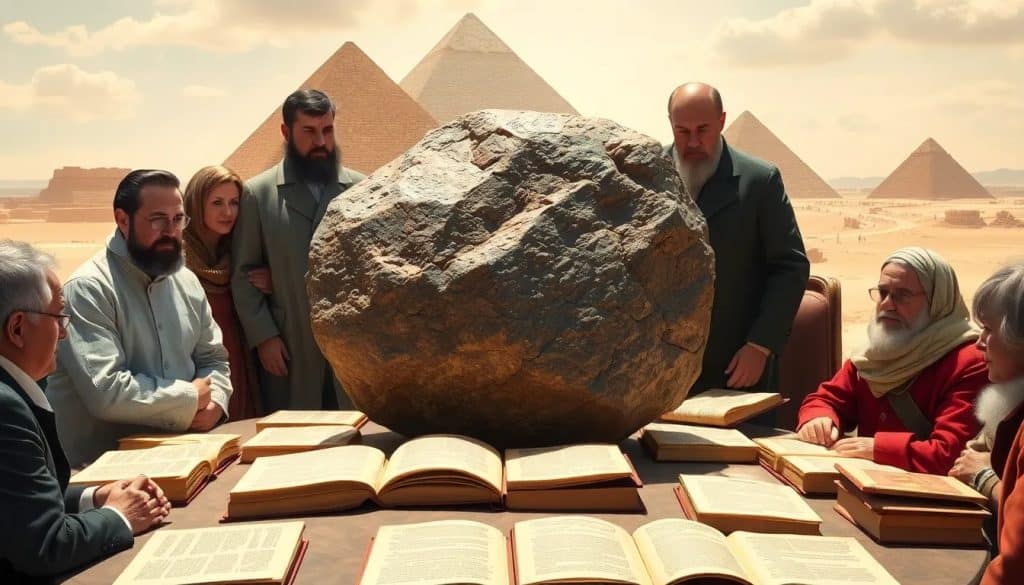
The Rosetta Stone is one of the most significant archaeological discoveries in history. Discovered in 1799, it is important because it was the key to understanding and deciphering Egyptian hieroglyphs. This article explores its discovery, the key figures involved in deciphering it, and its impact on the study of Egyptology.
What Is the Rosetta Stone and Why Is It Important?
The Rosetta Stone is a fragment of a granite stele bearing a decree issued in 196 BC by King Ptolemy V. The decree was inscribed in three languages: Egyptian hieroglyphs, Demotic script, and Ancient Greek. Its discovery made it possible to understand a language that had remained a mystery for centuries.
Its importance lies in the fact that the Greek texts were understandable to scholars of the time, making it easier to compare the different writing systems. As a result, the stone became the essential tool for deciphering hieroglyphs, opening a window onto the past of ancient Egypt.
The Rosetta Stone has also helped reconstruct cultural, social, and political aspects of the period, providing a more complete picture of Egyptian civilization. Its role as a bridge between languages and cultures has made it one of the most valuable artifacts in the history of archaeology.
How Was the Rosetta Stone Discovered?
The Rosetta Stone was discovered in 1799 by a group of French soldiers excavating in Rashid, a town near the Nile Delta. The find was made during Napoleon's military campaign in Egypt. When the soldiers identified the stone, they had no idea how important it would become to history.
Once found, the stone was taken to France, where it attracted the interest of several scholars, including the famous Egyptologist Thomas Young. Young was one of the first to study the stone and managed to identify some hieroglyphic characters. However, his work was not enough to fully decipher the text.
The stone was eventually sent to the British Museum in 1802, where it remains today. Its display has allowed millions of people to see it and appreciate its significance. The historical context of its discovery has contributed to the fascination surrounding this remarkable artifact.
Who Was Jean-François Champollion, and What Was His Connection to the Rosetta Stone?
Jean-François Champollion was a French linguist and Egyptologist, recognized as the leading figure in deciphering Egyptian hieroglyphs. His interest in ancient Egyptian civilization began at an early age, and he devoted much of his life to studying the Rosetta Stone.
After years of research, in 1822, Champollion announced his famous discovery: he had deciphered the hieroglyphic alphabet using the stone as a basis for comparison. This breakthrough marked a milestone in Egyptology and transformed our understanding of the Egyptian language and culture.
Champollion realized that hieroglyphs represented not only sounds but also ideas and concepts. His innovative approach enabled other scholars to follow in his footsteps, laying the foundations for modern Egyptology. His legacy lives on today, and his connection to the Rosetta Stone is key to understanding its impact on history.
What Does the Rosetta Stone Say?
The text on the Rosetta Stone is a decree issued by King Ptolemy V in 196 BC. The document recognizes the services rendered by the priests and sets out a series of rules and provisions concerning the worship of the pharaoh.
The decree emphasizes Ptolemy V’s divinity and virtues, as well as the benefits his reign brought to Egypt. The text is arranged in a way that made it easier to read in each of the three languages.
Thanks to the stone, we have learned more about the country’s administration, the relationship between the pharaoh and the priests, and the religious and social roles they played in Egyptian society. The Rosetta Stone has been essential to understanding how power was communicated in ancient Egypt.
How Were Egyptian Hieroglyphs Deciphered?
Deciphering hieroglyphs was a collaborative effort involving several scholars over many years. The first major breakthrough came from Thomas Young, who identified some hieroglyphic signs and linked them to the names of several pharaohs.
However, it was Champollion who carried out the most comprehensive work. He used the Rosetta Stone as the basis for his analysis and, by comparing the texts, developed a system demonstrating that hieroglyphs represented sounds, not just ideas. This revolutionary discovery made it possible to interpret ancient texts.
Champollion’s method combined language comparison with structural analysis of the signs. His multidisciplinary approach opened the door to a previously unknown world. His work helped Egyptology emerge as an academic discipline.
What Languages Are on the Rosetta Stone?
The Rosetta Stone features three types of writing, which makes it unique. They are:
- Egyptian hieroglyphs: Used mainly in sacred and ceremonial inscriptions, these characters represent both sounds and ideas.
- Demotic script: This was the most common form of writing in Egypt at the time, used for everyday and administrative documents.
- Ancient Greek: This language was widely used in administration and literature and was understood by scholars of the modern era.
The presence of these three languages on the Rosetta Stone was crucial to deciphering it. By comparing the texts, researchers were able to understand how each writing system worked and how they were related.
Interesting Facts About the Rosetta Stone
The Rosetta Stone has inspired many interesting facts that make it even more fascinating. Here are a few:
- Origin of its name: Its name comes from the city of Rashid (formerly Rosetta), where it was discovered.
- Material: It is made of granite, which has helped it withstand the passage of time and preserve its inscriptions.
- Exhibition: The stone is currently housed at the British Museum, where it is one of the most popular and frequently visited objects.
- Digitization: The stone has now been digitized in 3D, allowing researchers and curious visitors around the world to study it virtually.
- Cultural impact: The Rosetta Stone has influenced numerous works of art, literature, and film, becoming a symbol of the connection between cultures.
These facts highlight the importance and appeal of the Rosetta Stone, not only in academia but also in popular culture.
Related Questions About Deciphering Egyptian Hieroglyphs
How Was the Rosetta Stone Deciphered?
Deciphering the Rosetta Stone involved years of research and collaboration among several scholars. The key was comparing the texts in the different languages on the stone. Jean-François Champollion used the Greek inscriptions as a reference to understand the hieroglyphs and Demotic script. His method, based on comparative analysis and the study of phonetics, was crucial to arriving at the correct interpretation.
Champollion published his findings in 1822, revealing how hieroglyphic signs represented sounds and marking a milestone in Egyptology. This discovery enabled researchers to understand not only the language but also Egyptian culture and history.
Who Deciphered the Egyptian Hieroglyphs on the Rosetta Stone?
The decipherment of the Rosetta Stone’s hieroglyphs is due largely to Jean-François Champollion, who is recognized as the person primarily responsible for this achievement. After studying the work of other scholars, such as Thomas Young, Champollion successfully interpreted the hieroglyphic system, establishing a crucial link between the signs and their meanings.
His work not only made it possible to understand the Rosetta Stone but also laid the foundations for the study of Egyptian language and culture. Thanks to him, a new chapter in Egyptology began.
What Does the Rosetta Stone Describe?
The Rosetta Stone describes a decree issued in 196 BC by King Ptolemy V. The text recognizes the priests for their loyalty and the services they rendered to the pharaoh. The decree includes provisions concerning the worship of the pharaoh and his divinity, as well as the virtues attributed to him.
The text highlights the pharaoh’s importance in the daily lives of Egyptians and his relationship with the gods. The stone is therefore a valuable document that provides information about politics and religion in ancient Egypt.
How Did Jean-François Champollion Decipher Egyptian Hieroglyphs?
Jean-François Champollion deciphered Egyptian hieroglyphs by conducting a comparative analysis of the Greek text and the hieroglyphs. He studied the frequency of certain signs and their relationship to proper names, which allowed him to identify some characters as alphabetic.
His methodical approach and deep knowledge of ancient languages were decisive to his success. In 1822, he announced his discovery, having successfully interpreted the hieroglyphic system. This not only transformed our understanding of Egyptian writing but also allowed historians to access a vast body of ancient texts that had remained inaccessible.