
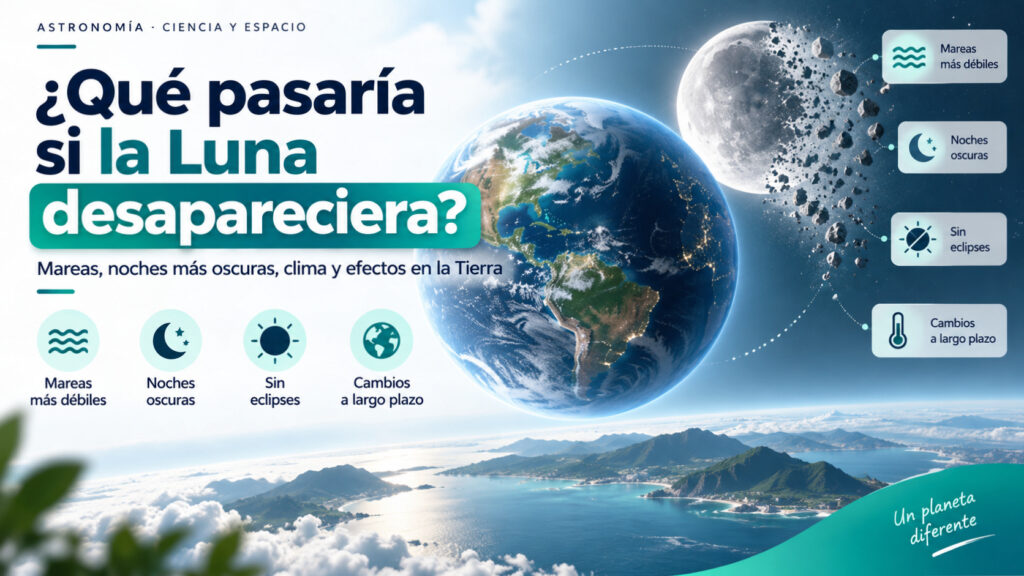
What Would Happen If the Moon Disappeared? How Earth Would Change
Nights would be much darker and tides would change almost immediately, but other consequences would take thousands or even millions of years to unfold. We explore what would really happen if the Moon disappeared, were destroyed, or had never existed.
Quick answer: If the Moon disappeared today, Earth would not leave its orbit, and our days would not suddenly become six hours long. Nights would be much darker, lunar and solar eclipses would no longer occur, tides would be considerably weaker, and, over the very long term, Earth's axial tilt could vary more than it does now.
The Moon may look virtually unchanged when we observe it from Earth, but it isn't. In September 2026, NASA announced the discovery of McGetchin, a lunar crater about 222 meters wide and 43 meters deep that had not been there a few years earlier.
Scientists determined that an asteroid or comet, probably about 10 to 20 meters across, struck the lunar surface between April and May 2024. The impact was so extraordinary that a new crater of that size is estimated to form on the Moon only about once a century.
The news raises a far more extreme question: could an object destroy the Moon, and what would happen to us if our natural satellite disappeared?
This is a hypothetical scenario—we know of no object that is going to make the Moon disappear—but it is a useful way to understand just how much our natural satellite affects Earth.
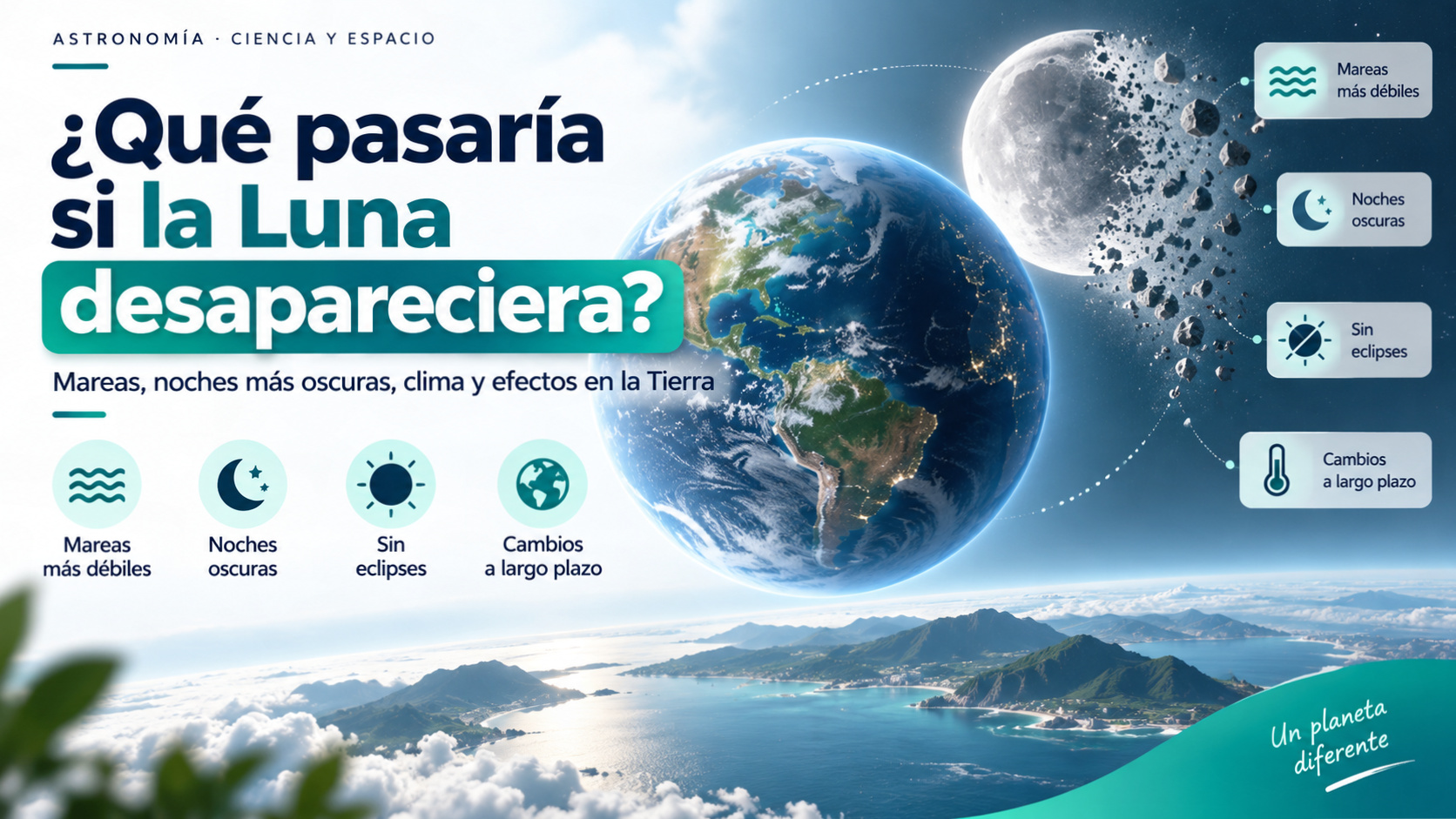
First: disappearing, being destroyed, and never having existed are not the same
One reason we find such different answers to the question what would happen if there were no Moon is that three scientifically very different scenarios are often confused.
The Moon disappears today
We imagine it magically disappearing without leaving any debris. This is the most useful scenario for studying its current effects on Earth.
The Moon is destroyed
Here, the additional problem would be its fragments. Depending on how it was destroyed, they could clump together again, remain in orbit, or some could move into dangerous trajectories.
The Moon never existed
Earth's entire history would have been different: its rotation, evolution, tides, climate, and probably life forms themselves.
What would we notice during the first night without the Moon?
The first consequence would be spectacular but not catastrophic: the night sky would be much darker.
The Moon does not produce its own light. What we call moonlight is actually sunlight reflected off its surface. Without the Moon, every natural night would look much more like a night with a new moon.
For astronomers, this would be an advantage. Away from cities, the Milky Way and many faint objects in the sky would be easier to observe without the glow of the Moon.
The phases of the Moon and eclipses as we know them would also disappear. Solar eclipses could no longer occur because there would be no Moon to pass between the Sun and Earth, and lunar eclipses would be impossible too because there would be no satellite to pass through our planet’s shadow.
If you want to better understand why we see different shapes of our satellite throughout the month, you can also find this activity about the phases of the Moon for children on Recomiendo.es.
What would happen to the tides if there were no Moon?
This would be one of the most important physical changes, and also one of the most commonly misunderstood.
The tides would not disappear. The Sun also exerts tidal forces on Earth. Its tide-generating effect is approximately half that of the Moon, although the actual height of a tide depends greatly on the shape of each coastline, the depth of the sea and other local factors.
So we would still see the sea level rise and fall periodically, although lunar tides would cease to exist and the tidal range would be considerably smaller than it is today in many areas.
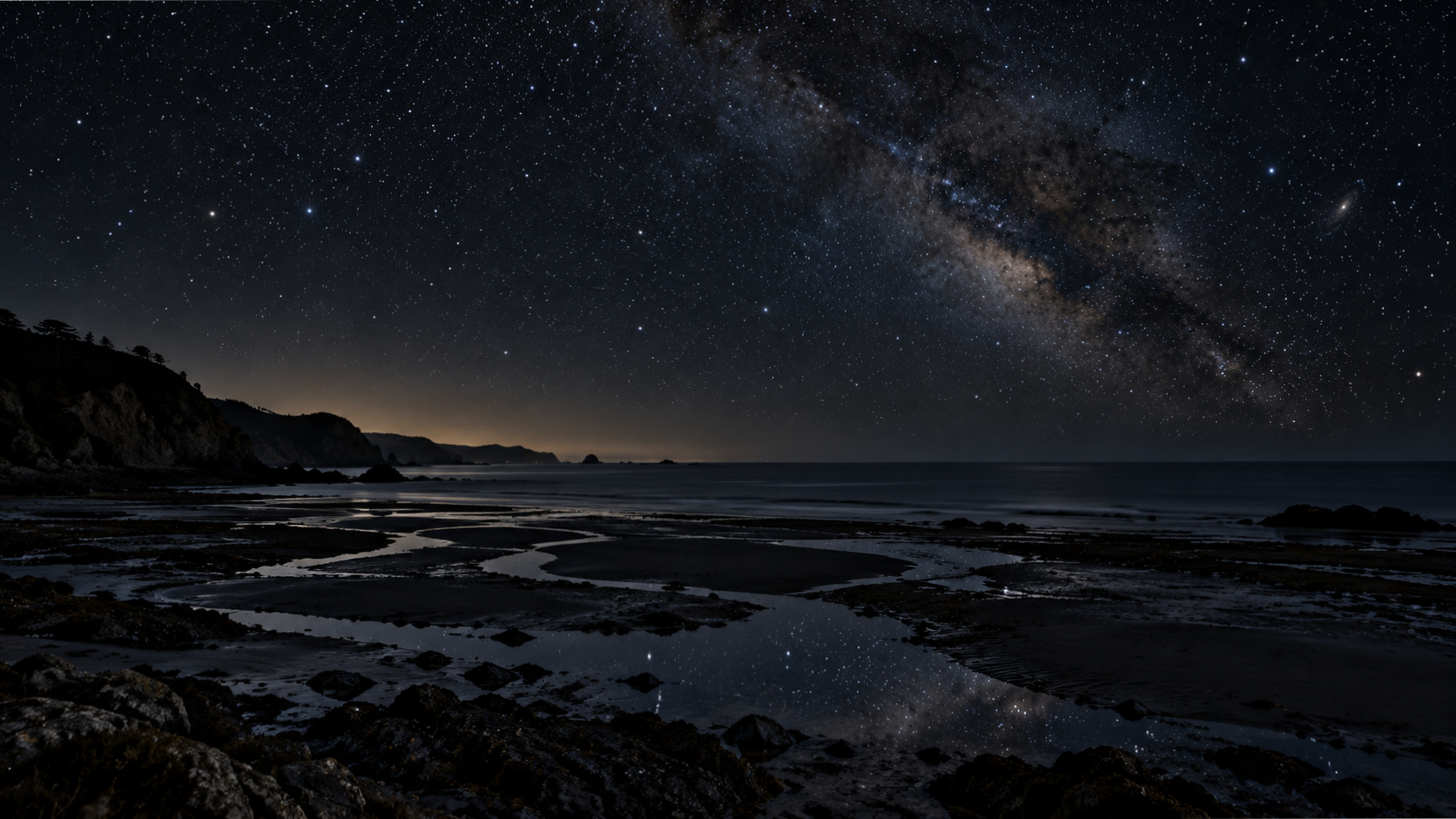
In an estuary, salt marsh or beach with a large intertidal zone, for example, the area alternately covered and uncovered by water would change. This would affect organisms specifically adapted to living between high and low tide.
Would the waves disappear too?
No. Waves and tides are different phenomena. Many of the waves we see at the beach are formed by wind acting on the water’s surface. Storms and large waves could still occur even without the Moon.
For a surfer, for example, the sea would not become a perfectly flat swimming pool. What would change significantly are the tidal cycles that waves currently overlap with.
Would days become 6 or 8 hours long?
Not if the Moon disappeared tomorrow.
This is probably the most interesting misconception that keeps coming up when people talk about a Earth without the Moon.
The Moon’s gravity creates tides, and the friction associated with them is very gradually slowing Earth’s rotation. According to measurements used by NASA, this effect currently contributes to an increase in the length of the day of a few milliseconds per century.
If the Moon disappeared today, Earth would retain practically the same rotation speed it has now. Tomorrow, a day would still be close to 24 hours long. What would disappear is much of this lunar braking effect, so the future evolution of Earth’s rotation speed would be different.
A simple example: imagine a spinning top that has been gradually slowing down for billions of years. Removing the brake would not instantly make it spin as fast as it did when it first started turning. It would simply stop losing speed in the same way.
So where do days of 6, 8 or 10 hours come from?
Those figures refer to a different scenario: an Earth that never had a Moon.
The early Earth spun much faster than it does now. Over billions of years, tidal interactions with the Moon have transferred angular momentum and helped slow this rotation.
If our satellite had never formed, Earth’s evolution would have been different, and the day today would probably be considerably shorter. The exact figure depends on the model used, so claiming that it would last exactly six or eight hours creates a false impression of precision.
What would happen to Earth’s axis and climate?
Here we find one of the Moon’s less visible roles.
Earth’s axis of rotation is tilted about 23,4 degrees relative to its orbit. This tilt is one of the reasons we have seasons and determines how solar energy is distributed across different latitudes throughout the year.
Having a relatively large Moon helps stabilize variations in Earth’s tilt.
Without it, the axis could undergo greater oscillations due to gravitational interactions with other bodies in the Solar System. But again, an important qualification is needed: Earth would not start tipping over chaotically the week after the Moon disappeared.
We are talking about astronomical processes that unfold over hundreds of thousands or millions of years.
Early studies popularized extreme scenarios in which Earth’s tilt could range across a vast span. Later simulations found that an Earth without the Moon could maintain a much more limited tilt for very long periods than those extreme scenarios suggested, although its variations would be greater than those of our current Earth.
This matters because the tilt of Earth’s axis affects the climate. In fact, some changes in Earth’s orbit are associated with long-term climate cycles, a topic we also explain in why glacial cycles occur approximately every 100.000 years.
What would happen to animals if the Moon disappeared?
To us, the Moon may seem like little more than a source of light, but millions of years of evolution have led many organisms to use lunar cycles, nighttime light or tides, directly or indirectly.
Various studies have found links between moonlight and activities such as foraging, risk of predation, migration, navigation and reproduction in different species.
A small nocturnal animal, for example, may move around less on a full-moon night to avoid being seen by a predator. Other species, by contrast, take advantage of moonlight to travel or find their way.
In the ocean, the impact would be even more profound. Many coastal organisms synchronize parts of their lives with daily, tidal, semilunar or lunar cycles. A major change in tides would transform intertidal habitats and force many species to adapt.
This does not mean that all life would disappear immediately. Some species might adapt, while others would struggle. The outcome would depend on each ecosystem and the time available for evolution.
Could we live without the Moon?
If our satellite magically disappeared tonight, humans would not die tomorrow.
We would keep breathing as usual, Earth’s gravity would remain practically unchanged, the planet would continue orbiting the Sun, and the length of the day would remain close to 24 hours.
The major problems would arise in other ways: changes to the tides, ecological changes and, over extremely long timescales, a different evolution of Earth’s tilt and climate.
It would be a very different question to ask whether humans would exist on an Earth that had never had a Moon. Our planet is about 4.540 million years old—you can read more about this in our article on how old Earth is—and small changes in the initial conditions would have altered billions of years of evolution.
Life might have emerged on such a planet, but it would be extremely unlikely for evolution to have led to us exactly as we are.
And what would happen if the Moon exploded or were destroyed?
This scenario is much more complex than making the Moon magically disappear.
The Moon is a huge body held together by its own gravity. Breaking it into pieces does not necessarily make it disappear. If the fragments did not receive enough energy to escape one another, their own gravity would tend to draw some of the material back together over time.
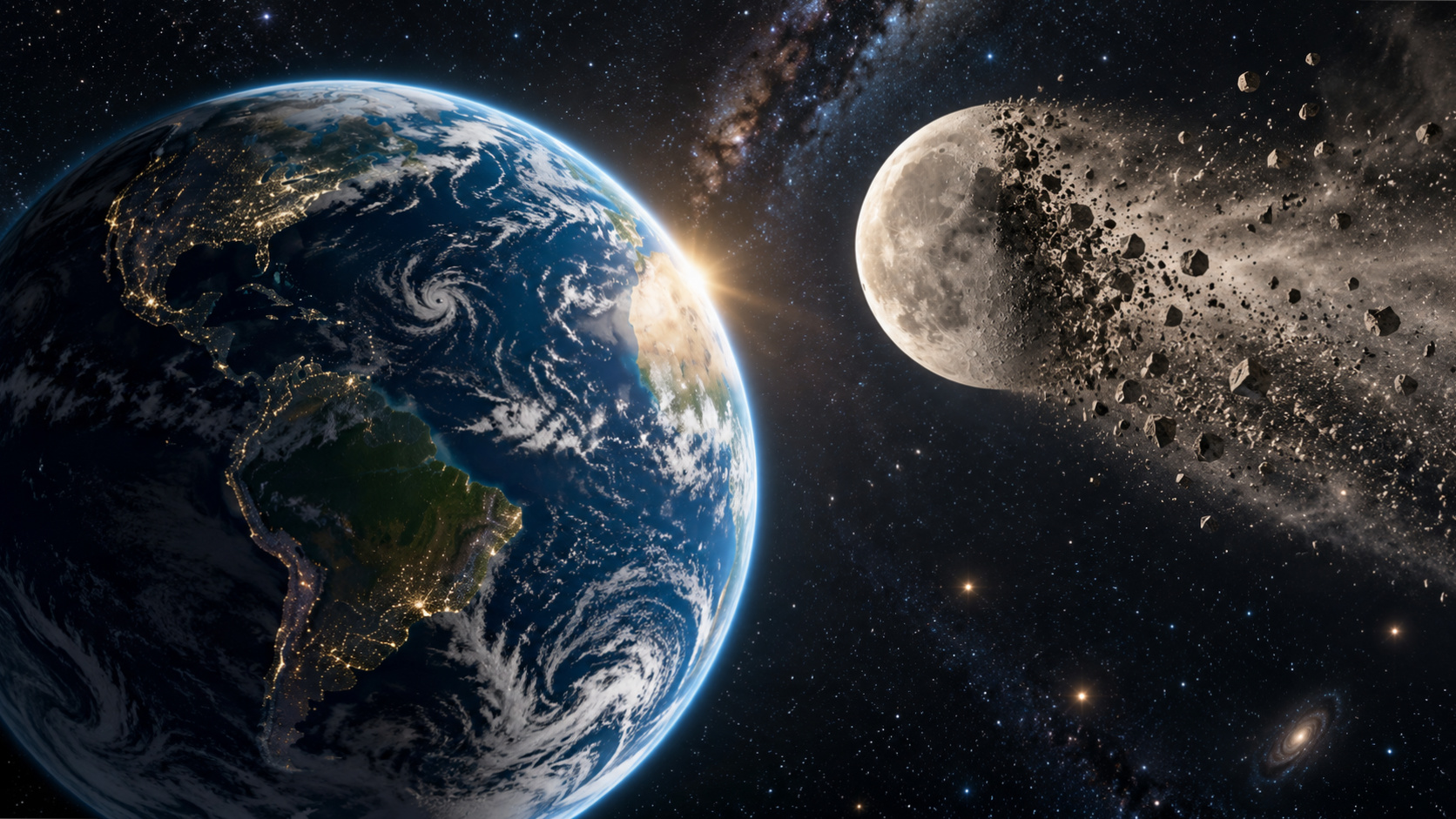
Depending on the force and direction of the impact, some of the debris could remain in orbit around Earth, temporarily form structures resembling a debris disk, reassemble, or follow different trajectories.
The key difference: if the Moon simply disappears, there is no debris. If it is physically destroyed, the fragments could become the most immediate problem.
If a significant amount of this debris followed trajectories that crossed Earth's orbit, there would be a risk of impacts. But it cannot be said that “all the pieces would fall to Earth”: the outcome would depend entirely on the fragments' speeds and orbits.
Would Earth leave its orbit if the Moon disappeared?
No.
Earth orbits the Sun primarily because of the Sun's enormous gravitational pull. In reality, the Earth and Moon orbit a shared center of mass located inside our planet.
If the Moon disappeared, the motion of the Earth-Moon system would change slightly, but our planet would continue to orbit the Sun.
So we would not be flung into space or automatically fall toward the Sun.
Would we weigh less without the Moon?
In practice, we would not notice any difference in our everyday weight.
The gravity that keeps us on the ground depends mainly on Earth's mass. Although the Moon exerts a gravitational pull on us—as it does on the ocean and the rest of the planet—its local effect is tiny compared with Earth's gravity.
We would not start jumping higher, and objects would not weigh noticeably less.
Does the Moon protect us from asteroids?
It's easy to imagine the Moon as a giant shield that takes impacts meant for Earth, especially when you see how many craters cover its surface. However, it does not act as a decisive protective shield.
The Moon occupies only a very small part of the sky when viewed from the possible paths of near-Earth objects. Some bodies that might be headed our way could hit it first, and its gravity can also slightly alter certain trajectories. But its disappearance would not mean that we would start facing a constant shower of asteroids.
In fact, Earth has also experienced countless impacts. The visual difference is that our atmosphere destroys many small objects, while erosion, water, vegetation, and tectonic activity gradually erase many ancient craters. On the Moon, they can remain for billions of years.
A world without the Moon would also be culturally very different
Not all the effects would be gravitational.
Since ancient times, the phases of the Moon have been used to organize calendars, religious festivals, navigation, agriculture, and timekeeping. Even our word “month” is historically linked to the lunar cycle in many cultures.
Thousands of references in literature, music, mythology, film, and everyday language would disappear.
And a fundamental part of the history of science and space exploration would be gone, from the first telescopic observations of its surface to the Apollo missions and today's programs to return to the Moon.
What's true and what's not about a world without the Moon
| Claim | What would really happen? |
|---|---|
| All tides would disappear | No. Tides caused mainly by the Sun would continue, although they would be different and generally weaker. |
| The sea would have no waves | No. Wind would continue to generate waves. |
| The day would soon last 6 hours | No. Earth's current rotation would remain practically the same. What would change is its future evolution. |
| Earth would leave its orbit | No. It would continue to orbit the Sun. |
| Earth's gravity would disappear | No. The gravity we feel depends essentially on Earth itself. |
| All living things would die immediately | No. There would be major ecological changes, but many would happen gradually. |
| The climate would be different in the long term | Yes. The Moon helps limit variations in the tilt of Earth's axis. |
How the Moon's disappearance might feel over time
Frequently asked questions about what would happen without the Moon
What would happen if the Moon suddenly disappeared?
The most obvious immediate consequences would be darker nights, the disappearance of lunar phases and eclipses, and a change in the tides. The major effects on the stability of Earth's axis would take a very long time to emerge.
What would happen if there were no Moon?
If the Moon had never existed, Earth would have had a different history of rotation, tides, climate, and evolution. We cannot assume that human beings would ever have appeared.
What would happen if the Moon exploded?
It would depend on the energy of the explosion and the speed of the fragments. Many could remain gravitationally bound, regroup, or stay in orbit, while some could end up on dangerous trajectories.
Could we live without the Moon?
Yes, we could survive its immediate disappearance. A different question is how ecosystems and the climate would change over much longer periods.
What would happen to the oceans without the Moon?
There would still be oceans, waves, and tides. The tides would be different because the Sun's tidal forces would continue to act, but the Moon's contribution would disappear.
How long would a day last without the Moon?
If the Moon disappeared now, a day would last about as long as it does today. Estimates of much shorter days refer to a hypothetical Earth that had never had a Moon over billions of years.
Does the Moon affect Earth's climate?
Indirectly, yes. Its gravity helps stabilize variations in the tilt of Earth's axis, which affects the distribution of solar radiation and the seasons.
Does the Moon protect Earth from asteroids?
It can intercept some objects and alter certain trajectories, but its role as a shield is limited. The large number of craters on the Moon is mainly because it lacks a substantial atmosphere and the geological processes that would erase these scars.
What would happen if the Moon collided with Earth?
This is a completely different scenario from the Moon disappearing, and it would be catastrophic. A body with the Moon's mass could not hit Earth without releasing an extraordinary amount of energy and profoundly transforming both bodies.
The Moon is far more important than it seems
When we look at the Moon, it seems like nothing more than a huge rock accompanying Earth. However, billions of years of gravitational interaction have made its presence an integral part of how our planet works today.
If it disappeared tonight, there would be no instant apocalypse. The first sunrise would come at almost the usual time, and we would still weigh the same. But the tides would be different, many species would lose one of the environmental cycles they have adapted to, and over astronomical timescales, our planet would evolve differently.
And if the Moon had never existed, the question would no longer simply be how we would live without it, but something far more profound: would we ever have come into existence?
You may also be interested in
What happened in the universe on your birthday? Hubble has the picture


