The letter ñ, called eñe in Spanish, originated in the Middle Ages as a shortened way of writing a double n: “nn”. Medieval scribes placed a small mark above the n to save space and time when copying manuscripts. Over the centuries, this abbreviation eventually became a letter in its own right in Spanish.
So, when someone asks where the letter ñ comes from, the short answer is this: ñ derives from an old way of writing nn, used to represent a sound that Latin did not have and that became very common in Spanish words such as año, niño, España, señor and sueño.
Quick summary: the letter ñ comes from a medieval abbreviation for a double n. Scribes wrote an n with a small mark above it to show that another n had been omitted. That mark is called a tilde or virgulilla in Spanish, and it gave rise to the letter ñ as we know it today.
What Is the Letter Ñ?
The eñe is the name of the letter ñ. In the modern Spanish alphabet, it comes after n and before o. Although it looks like an n with a little line above it, it is not simply a decorative variant: it is a letter in its own right.
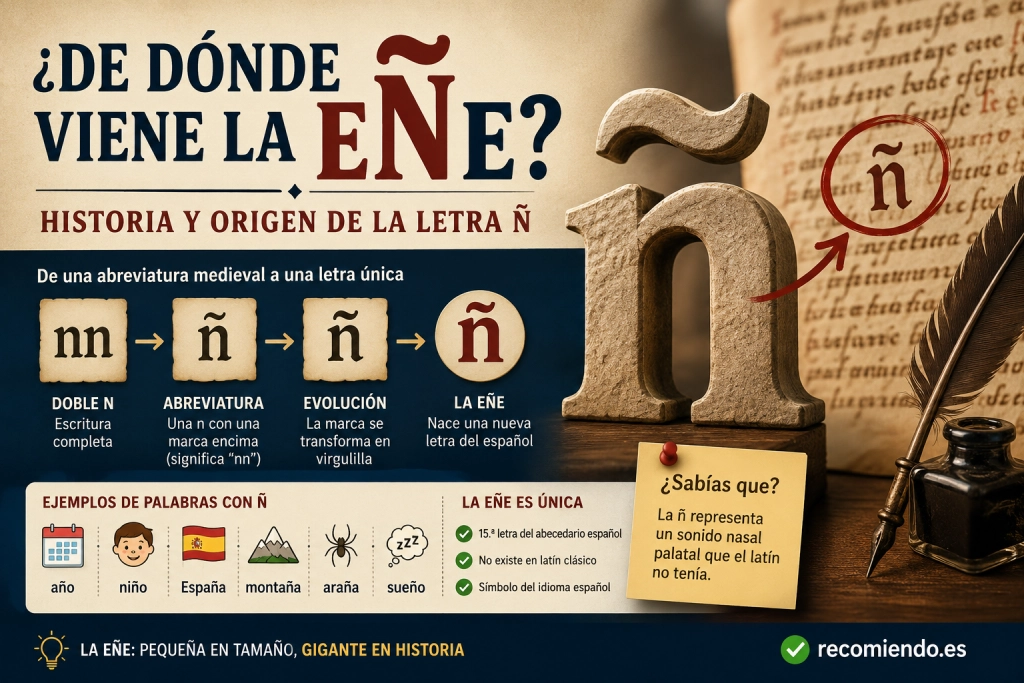
The letter ñ represents a palatal nasal sound. Simply put, it is the sound found in words such as:
- niño
- año
- mañana
- señal
- España
- sueño
If ñ is replaced with n, many words lose their correct pronunciation and may even change meaning. año (year) is not the same as ano (anus), nor is peña (rocky crag or group of people) the same as pena (sorrow or pity). That is why ñ is no minor detail: it is an important letter for writing correctly in Spanish.
Where the Letter Ñ Comes From
The letter ñ comes from medieval writing. In the Middle Ages, copyists and scribes had to copy texts by hand. To save space, time, and materials, they used many abbreviations. One such abbreviation involved writing a single n with a small line above it to represent a double nn.
Over time, this shortened n began to be used to represent a sound specific to medieval Castilian: the sound we now write as ñ.
The development can be summarised as follows:
- Latin had words containing letter combinations such as nn, gn, mn, and similar combinations.
- As Latin developed into the Romance languages, some of these sounds changed.
- Medieval Castilian needed a way to represent this new sound.
- Several spellings were used for a time.
- Eventually, the abbreviation for nn prevailed: an n with a mark above it.
- This form eventually became the letter ñ.
Why a Line Was Written Above the N
The small line above the n served as an abbreviation mark. In medieval manuscripts, it was common to place marks above a letter to indicate that another letter or part of a word had been omitted.
In the case of ñ, the mark indicated that the n stood for a double n. In other words, instead of writing nn, scribes wrote a single n with a mark above it.
Over time, the mark became more recognisable and took on the wavy shape we now associate with ñ.
What Is the Mark Above the Ñ Called?
The mark above the ñ is called a tilde or a virgulilla. Many people think the Spanish word “tilde” refers only to the accent mark in words such as camión, rápido, or café, but it can also refer to the mark above the ñ.
The Spanish word virgulilla is used especially to refer to that small wavy line. So, when talking about ñ, you can say:
- The tilde on the ñ.
- The virgulilla on the ñ.
- The little line over the eñe.
In everyday language, “the little line over the ñ” is perfectly clear, but if you want to use the more precise term, you can say virgulilla.
Why Spanish Has the Letter Ñ
Spanish has the letter ñ because it needed to represent a sound that did not exist as such in Classical Latin. As Latin evolved on the Iberian Peninsula, new sounds emerged in the Romance languages. One of them was the palatal nasal sound that we now write with ñ.
Other languages represented this sound differently. For example:
| Language | Common form | Example |
|---|---|---|
| Spanish | ñ | año, niño, España |
| Catalan | ny | Catalunya |
| French | gn | Espagne |
| Italian | gn | gnocchi |
| Portuguese | nh | Espanha |
Spanish took a distinctive approach to writing it: it turned that medieval abbreviation into a letter in its own right. This decision eventually gave rise to one of the most recognizable features of the Spanish language.
The eñe is more than a decorative mark
It is important to clarify that the tilde on the ñ did not begin as decoration. It was not placed above the n to make it look prettier, but to abbreviate a longer form of writing.
At first, the mark served a practical purpose. It helped save space in manuscripts and made it possible to copy more text with less effort. Later, this practical solution became a spelling convention.
This kind of evolution is very common in the history of writing. Many letters, symbols, and written forms used today come from practical solutions used by scribes, copyists, printers, or grammarians.
Examples of words with ñ
The ñ appears in many everyday words. Some well-known examples are:
- año
- niño
- niña
- señor
- señora
- sueño
- daño
- mañana
- montaña
- España
- español
- pañuelo
- baño
- araña
- piñata
These words show why the ñ is so important in Spanish. If it is removed, pronunciation changes and, in some cases, so does the meaning of the word.
What happens if you write n instead of ñ?
Writing n instead of ñ may seem like a small mistake, but it is not always one. In many words, it completely changes the meaning.
| With ñ | With n | Difference |
|---|---|---|
| año | ano | They are completely different words. |
| peña | pena | The pronunciation and meaning change. |
| caña | cana | They do not mean the same thing. |
| fingernail | a | One letter changes the entire word. |
So although some older keyboards or computer systems avoided the ñ, it must be used where appropriate in correct Spanish.
The ñ as a symbol of Spanish
The letter ñ is more than just a letter. It has also become a cultural symbol of Spanish and Hispanic identity. It is one of the spellings most readily associated with the language.
Its presence in words such as Spain, Spanish, sir and child gives it a very visible cultural significance. That is why efforts to protect the ñ have been important in technological, publishing and linguistic contexts.
For years, some computer systems, forms and databases did not handle the ñ correctly. This caused problems with names, surnames, addresses and documents. Compatibility is much better today, but errors can still occur when a system is not properly configured.
Does the ñ exist only in Spanish?
No. Although the ñ is especially associated with Spanish, it also appears in other languages. Some adopted it through Spanish influence or for their own writing needs.
The ñ can be found in languages such as Galician and Asturian, in certain uses of Basque, in some Indigenous languages of the Americas, and in other languages that have used spellings influenced by Spanish.
Even so, its strongest symbolic value is tied to Spanish, because it is one of the letters that most clearly sets its written form apart from other Romance languages.
Why people search for “ene” or “enie” on Google
Many people search for this topic by typing ene or enie because they do not have the ñ on their keyboard, do not know how to type it, or are using a device set to another language.
So although the correct name is eñe, searches such as these are also common:
- ene
- enie
- letter ene with a line
- n with a tilde above
- origin of the ñ
- where does the letter ñ come from
- what is the little line over the ñ called
The correct name of the letter is eñe. “Ene” is the letter n, while “eñe” is the letter ñ.
How to type ñ on a keyboard
On a Spanish keyboard, the ñ usually has its own key, normally located to the right of the letter L. But if you use an international keyboard or one set to another language, it may not appear directly.
Some common ways to type ñ are:
- On a Spanish keyboard: press the ñ key directly.
- On a mobile device: press and hold n, then select ñ.
- On some international keyboards: press and hold n until the alternatives appear.
- Copy and paste: use ñ or Ñ from another source if there is no other option.
The uppercase form is Ñ. The lowercase form is ñ.
Does the ñ have an accent?
No. The ñ does not have an accent. The mark above it is a tilde or virgulilla, but it does not function like the accent mark on a vowel.
In Spanish, accent marks are placed over vowels: á, é, í, ó, ú. The mark on the ñ does not indicate stress; it is part of the letter itself.
That is why we should not say that ñ is an n “with an accent.” It is more accurate to call it an n with a virgulilla or simply the letter eñe.
The importance of ñ in the history of the language
The history of ñ shows how a language evolves to adapt to the sounds it needs to represent. Spanish did not inherit a specific letter for that sound from Latin, so it eventually created its own written solution from a medieval abbreviation.
This makes the letter ñ a clear example of how writing does not appear all at once, but changes over time. First there was a practical need; then a writing convention; and finally, a letter recognized as part of the alphabet.
If you are interested in these kinds of stories about language, culture and the evolution of writing, you can also read the story of the Rosetta Stone, the story of Homer and Schliemann or the Roman gods in Rome.
So, what is the origin of the letter ñ?
The letter ñ originated as a medieval abbreviation of double n. Scribes wrote an n with a small mark above it to indicate that another n had been omitted. That mark, called a tilde or virgulilla, eventually became part of a new letter: ñ.
The ñ arose from a combination of phonetic need, writing economy and historical evolution. Spanish needed to represent a distinctive sound, and the written form that prevailed was the n with a virgulilla that we now recognize as one of the language’s most characteristic letters.
In short: the letter ñ is not simply a decorated n, but a letter with a history of its own, born in the Middle Ages and becoming one of the great symbols of Spanish.
Frequently asked questions about the ñ
Where does the letter ñ come from?
The letter ñ comes from the medieval abbreviation of double n. Copyists wrote an n with a small mark above it to indicate that another n was missing. That form eventually became the letter ñ.
What is the little line over the ñ called?
The little line over the ñ is called a tilde or virgulilla. It is not an accent like those used on vowels, but a mark that is part of the letter itself.
Is ñ a letter or an n with a tilde?
The ñ is a letter of the Spanish alphabet. Although it historically derives from an n with a mark above it, it is now considered an independent letter.
Why does Spanish have the letter ñ?
Spanish needed a way to represent a palatal nasal sound that did not exist in Classical Latin. The spelling that caught on was an n with a tilde: ñ.
Is ñ used only in Spanish?
No. Although it is especially associated with Spanish, ñ also appears in other languages—some use it because of Spanish influence, while others have their own spelling needs.
Is it correct to write “enie”?
That is not the correct spelling in Spanish. The correct form is eñe. “Enie” may appear in searches by people who do not have ñ on their keyboard, but the letter is called eñe.