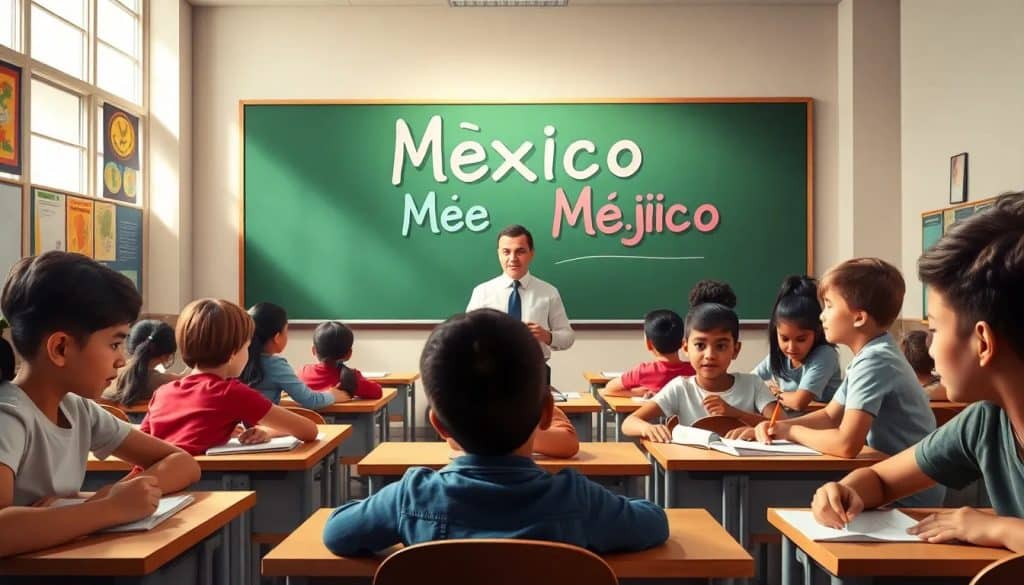
The spelling and pronunciation of the name “Mexico” have sparked an interesting cultural and linguistic debate over the years. The question “Why do we spell it Mexico but pronounce it Méjico?” comes up in both academic and everyday settings, reflecting the rich history of the Spanish language and its evolution in the Mexican context. In this article, we’ll explore the connection between the letter “x” and the pronunciation of j, along with other relevant aspects of the topic.
Why do we spell it Mexico but pronounce it Méjico?
The difference between the spelling and pronunciation of the name “Mexico” is a fascinating phenomenon rooted in the history of the Spanish language. In modern Spanish, the letter “x” represents a sound that has evolved over time. Although the Royal Spanish Academy (RAE) says that “Mexico” is the correct spelling, “Méjico” is the preferred pronunciation in some regions, especially in everyday speech.
This phenomenon is due to a series of spelling reforms and pronunciation changes that have taken place over the centuries. In medieval Castilian, “x” was pronounced differently, which has led to the current confusion. Cultural resistance to accepting the standard form also plays an important role, as many Mexicans feel a strong attachment to the traditional form.
What is the history of the letter x in the name Mexico?
The history of the letter “x” in the name “Mexico” can be traced to the Nahuatl word “Mēxihco.” In this language, “x” represented a sound similar to “sh,” which later shifted to a sound closer to the Spanish j in contemporary Spanish.
The use of “x” in the spelling of “Mexico” became established with the arrival of the Spanish conquistadors, who adopted and adapted Indigenous terms into their language. Over the centuries, various spelling reforms have sought to simplify and standardize spelling, but pronunciation has remained more variable.
- In the 19th century, the RAE established “Mexico” as the correct spelling.
- The influence of Latin American Spanish has helped preserve the pronunciation “Méjico.”
- Mexico’s Indigenous languages have left a profound mark on modern Spanish.
Why does the pronunciation of Mexico sound like an H?
Pronouncing “Mexico” as “Méjico” is the result of a process of phonetic change that has taken place in Spanish over the centuries. The letter “x” has changed from its original sound, which in earlier times represented a fricative sound similar to “sh.” Today, it is pronounced like the Spanish j in many parts of the Spanish-speaking world.
This phonetic change is not unique to Mexican Spanish. In other Spanish dialects, such as Spanish in Spain, “x” has undergone its own adaptations. This variation in pronunciation reflects the diversity of the language and its ability to adapt to different cultural contexts.
What does the RAE recommend for spelling Mexico?
The RAE has been clear in its recommendations regarding the spelling of “México.” The accepted and correct form uses an “x,” in keeping with the spelling convention established over the years. However, the Academy also recognizes the diversity of Spanish pronunciations, including “Méjico.”
The RAE’s most relevant recommendations include:
- Promote the use of “México” in formal and academic contexts.
- Respect linguistic and cultural diversity by taking regional pronunciations into account.
- Encourage the study of language history to better understand variations in spelling and pronunciation.
México or Méjico? A cultural and linguistic perspective
The choice between “México” and “Méjico” is not just a question of spelling; it is also deeply rooted in speakers’ cultural identity. For many people, the pronunciation “Méjico” represents a connection to the country’s traditions and history.
As a result, resistance to the form recommended by the RAE can be seen as a cultural assertion. “Méjico” is often used in informal contexts and by generations who grew up with this pronunciation, while “México” is more common in formal and academic writing.
How has the pronunciation of the letter J evolved in Spanish?
The letter “j” has had an interesting history in Spanish. Originally, “j” represented a sound similar to the “g” in “gente.” Over time, its pronunciation changed, and today it is associated with a more fricative sound in various parts of the Spanish-speaking world.
This change has been influenced by regional factors and interaction with other languages. In American Spanish, the pronunciation of “j” has been shaped by Indigenous languages, resulting in variations that can sometimes be difficult to trace.
Why does national identity affect the spelling of México?
National identity plays a crucial role in how “México” is written and pronounced. For many people, “Méjico” is associated with a sense of belonging and a connection to the country’s Indigenous roots. This pronunciation has been kept alive across generations, despite the RAE’s recommendations.
In addition, Mexico’s historical context, shaped by colonization and the struggle for independence, has influenced how people view the language. Resistance to accepting spelling changes can also be seen as a way of asserting the country’s history and culture.
Related questions about the spelling and pronunciation of México
Why is México spelled with an “x” but pronounced with an “h” sound?
The spelling of “México” with an “x” and its pronunciation as “Méjico” are the result of linguistic evolution. The “x” represents a sound that has changed over time, while the pronunciation “Méjico” has roots in the Nahuatl language. This phenomenon reflects the country’s history and culture, highlighting the diversity of Spanish.
Why is México spelled with an X?
The “x” in “México” comes from the Nahuatl language, where this character represented a different sound. It was adopted by the Spanish conquistadors and has been part of the country’s spelling ever since. The RAE upholds this spelling as correct, while the use of “j” reflects how the language has evolved.
Why the X in México?
The “x” in “México” has historical and cultural significance, symbolizing the fusion of Indigenous and European traditions. The evolution of its pronunciation has led to “Méjico” being used in many regions. This linguistic phenomenon highlights the complexity of the Spanish language and its adaptation to local contexts.
What does the X in México mean?
The “x” in “México” represents a cultural and linguistic legacy that connects Nahuatl roots with the evolution of the Spanish language. Its significance goes beyond a single letter, symbolizing a rich history of transformation and resistance that forms part of Mexicans’ national identity.