Wombat poop is cube-shaped because their intestines compact the waste in a unique way. It is not because they have a square anus, as is sometimes claimed online, but because of a combination of a very slow digestive process, very dry stool, and areas of the intestine with varying degrees of elasticity and stiffness.
This curious phenomenon has made the wombat one of Australia's most fascinating animals. Although it may seem like a simple oddity, the shape of its droppings has attracted scientists' attention because it helps us better understand how soft tissues can create fairly well-defined geometric shapes.
Quick summary: wombats produce cube-shaped poop because, as it travels through the intestine, the fecal matter dries out and compacts while passing through intestinal areas with varying degrees of elasticity. This combination ultimately creates edges and flatter faces.
Which animal poops in cubes?
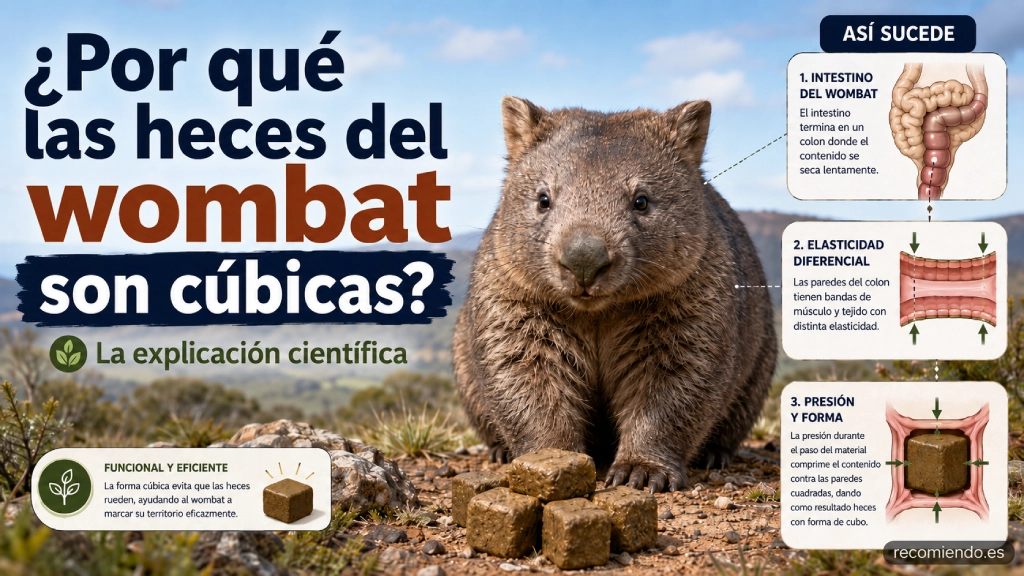
The animal best known for producing cube-shaped poop is the wombat, a herbivorous marsupial that lives in Australia. Unlike most mammals, which produce rounded, cylindrical or irregular droppings, wombats can produce small pieces of faeces with a distinctly cubic shape.
This does not mean that every piece is a perfect cube, as if it had come out of a mould. In reality, the pieces are usually compact, dry and have relatively flat sides. Some are squarer than others, depending on the animal’s hydration, diet and digestive process.
This curious fact is so striking that many people come across it wondering whether it is a myth. It isn’t: wombats really do produce cube-shaped faeces.
Why Is Wombat Poop Cube-Shaped?
The most widely accepted explanation is that wombat faeces take on this shape because of how they form inside the intestine. The process involves several factors:
- Slow digestion: food stays in the digestive system for a long time.
- Water loss: the faeces dry out and become more compact.
- Intestinal contractions: the intestine moves and shapes the faecal material.
- Differences in elasticity: some areas of the intestine are stiffer, while others are more flexible.
The key is that the wombat’s intestine does not exert the same pressure at every point. Because some areas are stiffer than others, the faecal material does not form into a uniform cylinder; instead, sides and edges develop. That is why the end result can look like a small cube.
Do Wombats Have Square Anuses?
No. This is one of the most common misconceptions. Wombats do not have square anuses. The cube shape does not form as the faeces leave the body; it develops earlier, as they move through the intestine.
For a long time, several theories were put forward: that the shape was caused by pressure from the pelvic bones, by a specially shaped sphincter, or even by a kind of natural mould at the end of the digestive tract. However, the strongest scientific explanation points to how the intestine works internally and compacts the faeces.
Put simply: the cube forms inside, not at the exit.
Why Do Wombats Produce Cube-Shaped Faeces?
The most common theory is that the cubic shape helps wombats mark their territory. These animals often deposit their faeces in visible places, such as on rocks, logs or raised areas. Because the pieces are cube-shaped, they are less likely to roll away.
This can be useful because wombats use the smell of their faeces as a signal. They communicate their presence to other individuals and mark out areas of activity. For animals that are mainly nocturnal and have limited eyesight, smell plays an important role.
The cubic shape, then, may be more than an anatomical oddity. It could serve a practical purpose: leaving more stable markers in the environment.
How Much Poop Can a Wombat Produce?
A wombat can produce many pieces of faeces in a single night. It is often said that they can leave dozens of droppings, or even close to a hundred, especially when actively marking routes or territory.
This amount makes sense when you consider that faeces are more than just digestive waste. For wombats, they can also serve as a means of communication. Each dropping leaves scent information on the ground.
Exactly How Do the Cubes Form?
Cube-shaped faeces form gradually. First, the food is digested slowly. Then, the faecal material loses water and becomes drier. Finally, as it passes through the last sections of the intestine, contractions and differences in tissue elasticity help shape it.
While other animals’ intestines produce more rounded or cylindrical shapes, pressure is distributed unevenly in wombats. Some areas of the intestine stretch more than others, eventually creating angles and flatter surfaces.
That is why wombat faeces are so interesting to science: they show that soft tissue, without rigid corners, can produce fairly well-defined geometric shapes.
Are They Perfect Cubes?
Not always. Although they are known as “cube-shaped faeces”, not every piece is a perfect cube. Some are squarer, others more irregular, and some simply have several flat sides.
The shape can vary depending on the wombat’s hydration, diet, digestive health and environmental conditions. If the faeces contain more moisture, they may lose some of their characteristic shape.
So rather than picturing mathematically perfect cubes, it is better to think of small, dry, compact blocks that tend to have flat sides.
What Do Wombats Eat?
Wombats are herbivores. Their diet consists mainly of grasses, roots, bark and other plant matter. Since many of these foods are fibrous and low in water, their digestive system is adapted to make the most of the nutrients and conserve fluids.
This slow, efficient digestion helps make their faeces very dry. That dryness is one of the factors that allows them to retain a more defined shape.
This kind of adaptation brings to mind other fascinating facts about the animal kingdom, such as how some animals use seemingly strange behaviours to survive. You can also read about whether it is true that ostriches bury their heads in the sand or find out which mammal is the most aggressive in the world.
Where Do Wombats Live?
Wombats live in Australia and typically inhabit forests, scrubland, grasslands and mountainous areas. They are sturdy burrowing animals, mainly nocturnal or crepuscular.
One of their best-known characteristics is their ability to dig burrows. They have strong legs, powerful claws and compact bodies, ideal for moving through tunnels and underground shelters.
Since they spend much of the day hidden and are mostly active at night, it is often easier to spot their presence through their tracks, burrows or faeces than to see the animal itself.
Why Is This Discovery Interesting to Science?
The question may seem amusing, but it is more significant than it might appear. Understanding how a wombat’s intestine produces cube-shaped forms could help researchers study how soft tissues generate specific structures without rigid moulds.
This knowledge could have applications in fields such as biomechanics, soft-material manufacturing and even the study of some digestive processes. Nature solves physical problems in surprising ways, and the wombat is a good example.
The interesting thing is that an apparently simple question—why an animal poops in the shape of a cube—ends up connecting biology, physics, evolution and animal behaviour.
The Scientific Explanation vs. the Myth
Many simplified versions of this story are repeated online. Some say wombats have square anuses. Others claim the faeces are flattened as they come out. Neither explanation is the most accurate.
The most reliable explanation is this:
- No: wombats do not have square anuses.
- No: faeces do not become cube-shaped just by falling to the ground.
- Yes: the shape forms inside the intestine.
- Yes: dryness, compaction and the elasticity of intestinal tissue all play a role.
So when someone asks, “Why is wombat poop square?”, the short answer is: because the intestine shapes it that way before it is expelled.
Are There Other Animals That Produce Cube-Shaped Faeces?
The wombat is the best-known and most remarkable example. Many animals produce droppings in distinctive shapes: pellets, cylinders, irregular clumps, or forms adapted to their diet. But the wombat’s cube-shaped droppings are an especially striking rarity in the animal kingdom.
Other animals also have surprising adaptations related to their diet, defence, or how they move. For example, you can find more interesting facts in articles such as what is the smallest animal on the planet or how do dolphins stay hydrated if they cannot drink the water they swim in.
So, why are wombat droppings cube-shaped?
Wombat droppings are cube-shaped because of a combination of slow digestion, water loss, compression, and differences in elasticity in the intestine. As the faecal material moves through the digestive system, it gradually dries out and takes shape until it has flat faces and defined edges.
This shape may help the droppings stay where the animal leaves them, which is useful for marking territory and communicating with other wombats through scent.
In short: wombats don’t produce cubes by chance; it’s a very specific biological adaptation that combines digestion, physics, and animal behaviour.
Frequently asked questions about cube-shaped wombat droppings
Are wombat droppings really cube-shaped?
Yes. Wombat droppings can be cube-shaped or nearly cube-shaped. They are not always perfect cubes, but they do have flatter faces and more defined edges than the droppings of other mammals.
Why is wombat poo square?
Because it takes shape inside the intestine through a process involving compression, water loss, and uneven pressure. Areas of the intestine with different levels of elasticity help create flat faces and edges.
Does a wombat have a square anus?
No. That’s a myth. The cube shape is not caused by the wombat’s anus, but by the internal process that takes place in its intestine before the droppings are expelled.
What are cube-shaped wombat droppings for?
They are thought to help mark territory. Because of their more stable shape, they are less likely to roll when deposited on rocks, logs, or raised areas.
Do all wombats produce cube-shaped droppings?
Wombats are known for this characteristic, although the shape can vary. Some droppings are more cube-shaped, while others are more irregular, depending on the animal’s hydration, diet, and digestive health.