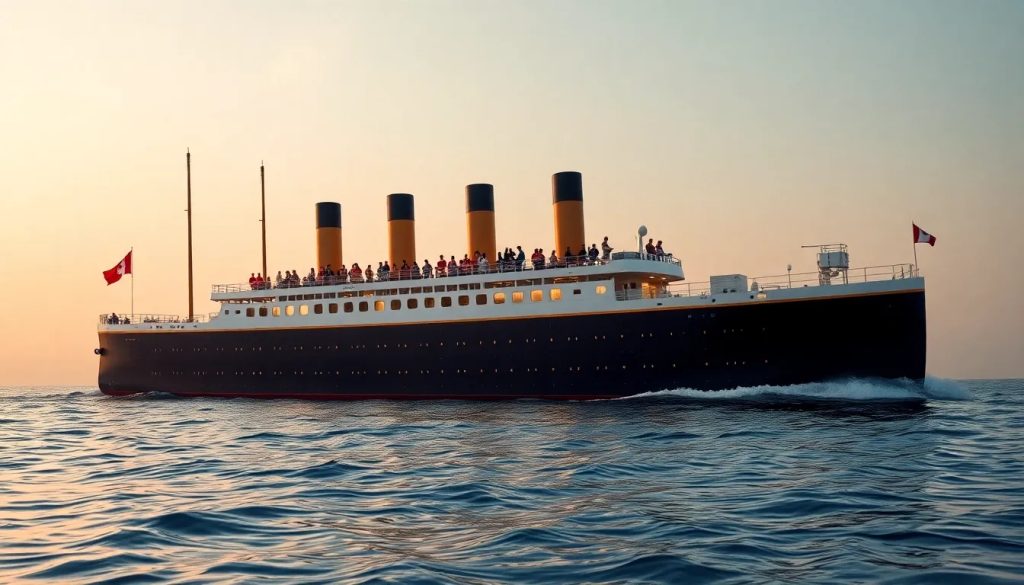
The sinking of the Titanic in April 1912 is one of the best-known maritime disasters in history. This tragic event, which resulted in the loss of more than 1500 lives, has given rise to numerous theories and speculations. In this article, we’ll explore why the Titanic would not have sunk today, examining the circumstances surrounding its fateful voyage and the conspiracy theories that have emerged since.
From its construction to its sinking, the Titanic has fascinated people. In this article, we’ll unravel the theories surrounding its sinking, the influence of figures such as J. P. Morgan, and the impact of the Federal Reserve on these events.
Why would the Titanic not have sunk today?
The question of why the Titanic would not have sunk today may seem rhetorical, but it invites us to consider advances in modern maritime technology and safety. In the Titanic’s time, safety measures were rudimentary compared with those in place today.
Modern ships are equipped with advanced technology, including:
- Iceberg detection systems.
- Better construction materials and structural design.
- More comprehensive safety procedures and crew training.
In addition, lessons learned from the sinking of the Titanic led to significant changes in maritime law. These changes include requiring enough lifeboats and improving communications at sea.
What are the conspiracy theories about the sinking of the Titanic?
There are many different conspiracy theories about the sinking of the Titanic. One of the most popular is the idea that the Titanic was swapped for its sister ship, the Olympic, as part of a plan to prevent the White Star Line from going bankrupt.
This theory, known as the “switch,” claims that the Olympic, which had previously been damaged, was disguised as the Titanic to cover up an accident. However, the lack of concrete evidence has led most historians to reject this claim.
Some of the most commonly cited arguments in these theories include:
- The similarity between the two ships.
- Accounts from passengers who claimed they saw the Olympic instead of the Titanic.
- Documents allegedly tampered with by the White Star Line.
Despite their popularity, these theories have been widely debunked by the scientific community and experts in navigation.
Who is behind the Titanic switch theories?
The Titanic switch theories have been promoted by various authors and online forums. These claims are often fueled by a desire to find a conspiracy behind tragic events.
Supporters of this theory often cite authors who have made bold claims without scientific backing. In addition, some groups have tried to link the Titanic narrative to the creation of the Federal Reserve, suggesting the sinking was part of a broader scheme.
It is important to note that, although the Titanic story is tragic, there is no evidence to support these claims. Naval history experts have pointed out that the arguments for a switch are more fiction than fact.
What evidence debunks the Titanic conspiracy theories?
There is a wealth of evidence debunking conspiracy theories about the Titanic, covering various aspects of the incident. First, the official inquiry into the sinking, led by the U.S. Senate Inquiry Commission, concluded that the Titanic sank after hitting an iceberg.
Evidence supporting this conclusion includes:
- Reports from the crew and survivors.
- The ship's log and route data.
- Images and accounts of the recovery of wreckage from the ocean floor.
The inquiry has been reviewed by numerous experts over the years, and the consensus is clear: the Titanic sank because of a series of human errors and design factors, not a cover-up.
How did the creation of the Federal Reserve affect the sinking of the Titanic?
Some theories suggest that the creation of the Federal Reserve played a role in the sinking of the Titanic, implying that the accident was an attempt to eliminate opponents of the creation of the U.S. central bank.
This narrative is based on the fact that several of the Titanic's major investors, such as Isidor Straus and Benjamin Guggenheim, were critics of the Federal Reserve. However, there is no solid evidence linking the sinking to the creation of the Federal Reserve.
Historians have argued that the conspiracy claims are unfounded and that the sinking of the Titanic was, in reality, an isolated tragedy with no political connections.
What role does J. P. Morgan play in Titanic conspiracy theories?
J. P. Morgan, one of the most influential bankers of his time, has been mentioned in numerous theories about the Titanic. It is said that he had financial interests in the White Star Line and may have been involved in a plan to get rid of opponents.
However, it is important to point out that Morgan was not aboard the Titanic on its maiden voyage, which weakens the validity of these theories. In addition, his connection to the ship has been distorted over the years.
Financial analysts have shown that claims about J. P. Morgan's role are more speculation than proven fact. Despite his notoriety, there is no evidence directly linking him to the sinking of the Titanic.
Could there have been a coal bunker fire on the Titanic?
One of the most intriguing theories suggests that the Titanic may have been on fire before it hit the iceberg. Some researchers have argued that a fire in the coal bunkers may have weakened the ship's structure.
However, this theory lacks solid evidence. Most experts agree that although there was a fire aboard the Titanic, it was brought under control before the ship sailed and had no significant impact on the sinking.
Investigations into the sinking have shown that the real factors were adverse weather conditions and the crew's lack of preparation for an accident of such magnitude.
Related questions about the sinking of the Titanic
Why can't the Titanic be salvaged?
The Titanic lies more than 3,800 meters below the surface of the Atlantic Ocean, making it extremely difficult and costly to salvage. In addition, the conditions on the seafloor, along with the ship's fragility, complicate any recovery attempt.
Efforts to recover the Titanic have been limited and have focused mostly on exploring and documenting its current condition, rather than physically salvaging it.
Why did they say the Titanic was unsinkable?
The Titanic was promoted as “unsinkable” because of its watertight compartments and advanced engineering. However, this claim proved to be wrong: a collision with an iceberg compromised multiple compartments, leading the ship to its tragic fate.
What could have prevented the Titanic from sinking?
A combination of better navigation practices, enough lifeboats, and proper crew training could have prevented the sinking. Lack of preparation and excessive confidence in the ship's features played a crucial role in the tragedy.
Why were no human remains ever found on the Titanic?
The depth and conditions of the ocean have made it difficult to recover human remains. In addition, the decomposition of the bodies and the marine environment have meant that, to date, no remains have been found at the site of the sinking.