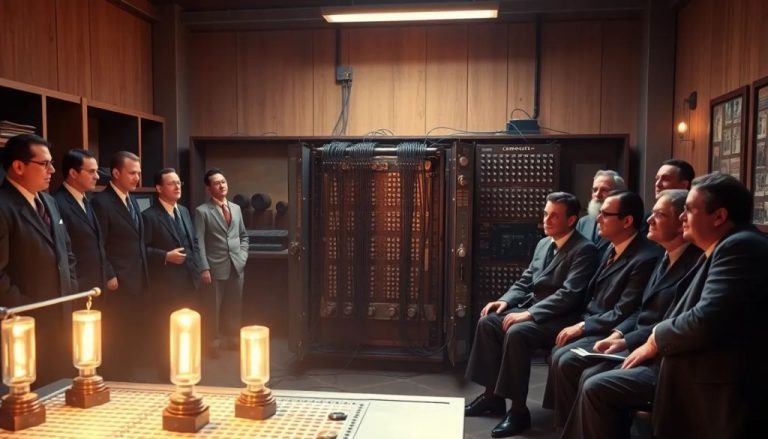
The cathode-ray tube (CRT) is a technology that has played a fundamental role in the history of image display. Invented in the late 19th century, it works by projecting electrons onto a phosphor-coated screen. Although it has been replaced by more modern technologies, its impact on the development of televisions and monitors is undeniable.
This article explores the most important aspects of the cathode-ray tube, from its history and how it works to its applications and legacy today. Join us on this journey through the evolution of display technologies.
How Does a Cathode-Ray Tube Work?
The way a cathode-ray tube works is both fascinating and technical. Essentially, the CRT emits electrons from a cathode, which are accelerated toward an anode. This process creates an electron beam that is directed toward the device’s screen.
When the electrons hit the phosphor-coated screen, they produce light. The beam’s intensity and direction are controlled by electrodes and magnetic coils, making it possible to create images at different brightness levels.
Color cathode-ray tubes use three electron guns, each assigned to a primary color: red, green, and blue. These colors combine to produce a wide range of hues on the screen, allowing images to be displayed in color.
What Is a Cathode-Ray Tube?
The cathode-ray tube, also known as a CRT, was widely used in televisions and computer monitors. Its invention is attributed to William Crookes in 1875, who developed the first prototype of this innovative device.
A CRT consists of a vacuum-sealed glass tube in which electrons are generated and accelerated toward a phosphor-coated screen. This process makes it possible to display images and videos, making the CRT an essential component of consumer electronics for more than a century.
Over the course of its development, the design and operation of the cathode-ray tube were improved in various ways, enhancing image quality and device efficiency. However, the advent of technologies such as LCD and LED has made it obsolete in most modern devices.
Thomson's Cathode-Ray Tube
J.J. Thomson, a British physicist, conducted crucial research on cathode rays in 1897, where he discovered the existence of electrons. This milestone was essential to understanding how the cathode-ray tube works and the nature of the rays it emits.
Thomson's contributions not only helped improve CRT technology but also laid the groundwork for future research in physics and electronics. His work earned him the Nobel Prize and made him a key figure in the history of science.
Thomson's legacy lives on in modern technology, as his discovery of electrons has been fundamental to the development of the many electronic applications we use today.
Cathode-Ray Tube: A Simple Explanation
To understand the cathode-ray tube, imagine a device that generates images through a process of electron excitation. Electrons are emitted by a cathode, accelerated, and directed toward a screen.
The screen is coated with a substance that glows when struck by electrons, thereby creating images. This process is repeated thousands of times per second, allowing videos and moving images to be displayed.
A CRT is made up of components such as a cathode, an anode, and deflection coils, which work together to control the path of the electron beam. This basic operating principle has been used in display devices for more than a century.
The Cathode-Ray Tube Experiment
The classic cathode-ray tube experiment demonstrates the existence of electrons. In this experiment, a cathode is placed in a vacuum and a voltage is applied, causing electrons to be emitted toward the anode.
When an electric field is introduced, the electrons are deflected, making it possible to observe their behavior and confirm that they are negatively charged particles. This experiment was not only fundamental to the discovery of electrons but also paved the way for understanding atomic structure.
This experiment had a profound impact, not only on physics but also on the development of display technology. The principles it revealed are still applied today in various areas of scientific research.
Cathode-Ray Tube Displays
Cathode-ray tube displays are an essential component of display technology. These screens are coated with phosphor, which emits light when struck by electrons. Image quality depends on the purity of the phosphor and the precision of the electron beam.
CRT screens are used in televisions and computer monitors, but their popularity has declined with the arrival of more advanced technologies. However, many enthusiasts still value CRT screens for their color quality and ability to display highly detailed images.
Today, designing and manufacturing CRT screens has become rare, but their legacy remains part of the history of display technology. Their impact on the evolution of electronic devices is undeniable.
Cathode-Ray Tube Voltage
Voltage is crucial to the operation of a cathode-ray tube. This device requires a high voltage to accelerate electrons from the cathode toward the anode, thereby generating the electron beam that will strike the screen.
Controlling the voltage makes it possible to adjust the intensity of the electron beam, which in turn affects the brightness of the image on the screen. The right voltage is essential for achieving good image quality and efficient device operation.
As technology advanced, the voltages required to operate CRTs were optimized, making it possible to create more compact devices with lower energy consumption.
Frequently Asked Questions About How Cathode-Ray Tubes Work and Their Applications
How does a cathode-ray tube work?
A cathode-ray tube works by emitting electrons from a cathode, which are accelerated toward an anode by a high voltage. This process generates an electron beam directed at a phosphor-coated screen, where the electrons produce light on impact.
Magnetic coils control the direction of the beam, allowing images to be displayed. Varying the intensity of the electrons creates different levels of brightness, producing moving images on the screen.
What is a cathode-ray tube?
A cathode-ray tube is a device used to display images. It was widely used in televisions and monitors before technologies such as LCD and LED emerged. Its invention is attributed to William Crookes, who developed the first prototype in 1875.
A CRT works by generating an electron beam that strikes a phosphor-coated screen, creating visible images. This technology was fundamental to the evolution of consumer electronics and has had a lasting impact on how we view multimedia content.
How does a CRT work?
A CRT works by emitting electrons from a cathode, which are then accelerated toward an anode by a voltage. This process generates an electron beam directed at a phosphor-coated screen, where each impact produces light and makes images visible.
The direction and intensity of the beam are controlled using electrodes and magnetic coils, making it possible to create images at different brightness levels. This technology was key to displaying images for more than a century.
How does the cathode-ray tube experiment work?
The cathode-ray tube experiment involves creating a vacuum inside the tube, where a cathode is placed. When a voltage is applied, electrons are emitted and travel toward the anode. This experiment makes it possible to observe electrons being deflected by electric or magnetic fields.
This phenomenon was crucial to discovering the nature of electrons and their negative charge. The experiment not only provided valuable insights into atomic structure, but was also fundamental to the development of modern display technology.