Important update · 5 October 2026
The Spanish Ministry of Finance has announced that the remaining requirements under the Regulation on Invoicing Computer Systems, popularly known as VeriFactu, are postponed until October 2028. The aim is to align its rollout with mandatory e-invoicing for small businesses, self-employed professionals and other business owners and professionals whose turnover does not exceed 8 million euros.
Digitizing a business no longer means simply replacing printed invoices with PDF files. The real change comes when sales, invoicing, payments, purchasing, accounting, payroll and inventory can share information without someone having to enter the same data multiple times.
This is taking place against a regulatory backdrop that requires greater attention to the software used for invoicing. One of the most common questions among businesses and professionals is when VeriFactu comes into force, especially after the various timeline changes in recent years.
The answer requires distinguishing between different concepts. VeriFactu, the new requirements for invoicing computer systems and mandatory e-invoicing between businesses are all related to tax digitalization, but they are not exactly the same requirement. This distinction is precisely why the Spanish Ministry of Finance has now chosen to align some of the timelines, avoiding successive technology updates within a short period.
The key points to understand
- October 2028: is the new target date announced by the Spanish Ministry of Finance for the remaining requirements under the Regulation on Invoicing Computer Systems.
- The dates of 1 January and 1 July 2027 belong to the previous timeline and have been superseded by the newly announced postponement.
- B2B e-invoicing is entering a separate phase: the timeline is triggered by Order HAC/1028/2026 and sets implementation for October 2027 for businesses with turnover above 8 million euros, and October 2028 for the rest.
- VeriFactu and B2B e-invoicing are still distinct concepts. The former concerns invoicing systems and records; the latter governs the structured electronic exchange of invoices between businesses and professionals.
- The VeriFactu postponement must be formally enacted in law. Until the relevant amendment is published, some consolidated legal texts and information pages may continue to show the previous dates for a time.
What is VeriFactu, and what does it actually change?
Spanish regulations on invoicing computer systems aim to ensure that the software used by business owners and professionals guarantees the integrity, preservation, accessibility, readability, traceability and immutability of invoicing records.
In practice, this changes how software must handle information. Certain records should not be able to be silently deleted or altered after an invoice has been issued, as if they had never existed.
Compliant systems must generate the relevant invoicing records, and invoices issued through them must include the elements required by the regulations, including a QR code.
However, there is an important distinction between the two modes of operation provided for.
VERI*FACTU system
It electronically sends the billing records generated by the system to the Tax Agency.
NON-VERI*FACTU system
It does not send records automatically, but it must meet additional requirements to ensure that records are preserved and remain unaltered.
That is why it is important to avoid a common oversimplification: for affected taxpayers, the core requirement is to use billing software that complies with the regulations. VERI*FACTU is one of the two options available.
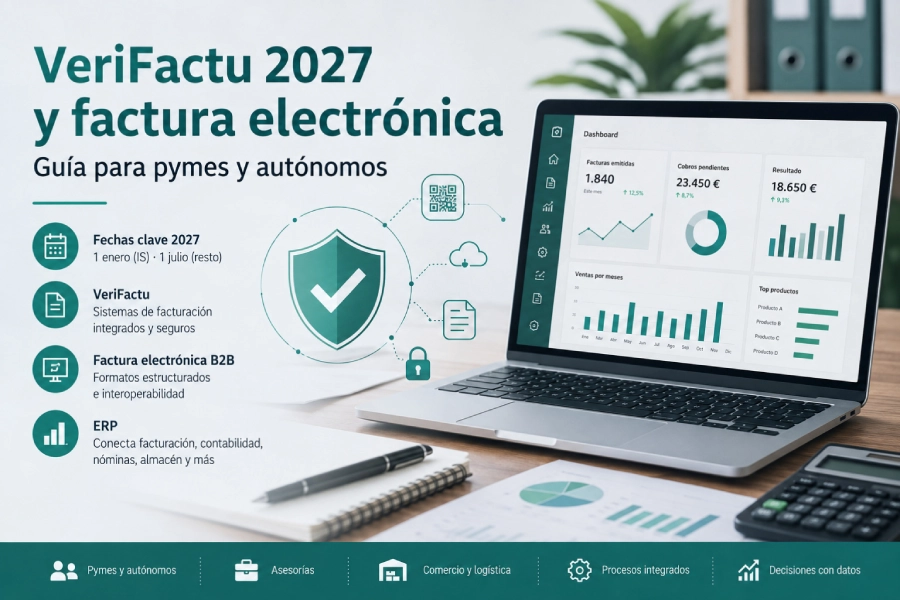
When will software need to be compliant following the latest postponement?
The VeriFactu timeline has changed again. On 5 October 2026, the Ministry of Finance announced that it would postpone until October 2028 the outstanding obligations under Royal Decree 1007/2023, which sets out the requirements for billing software.
The stated aim is to coordinate the introduction of these requirements with mandatory e-invoicing and avoid requiring SMEs and self-employed professionals to make two major changes to their billing processes within a short period.
Having more time now does not mean you should leave the transition until the last minute. A business that only needs to update its application may be able to make the change relatively easily. The situation is different, however, if it needs to replace its software, migrate thousands of customers and products, configure users, connect warehouses or train several employees.
Important about the date: As of this update, the Ministry of Finance has announced the latest postponement of VeriFactu, but the regulatory amendment formally replacing the 2027 deadlines has yet to be published. For legal or tax decisions that depend on a specific date, it is therefore advisable to check the final regulation once it is published.
There are also exemptions and specific provisions depending on the tax regime and territory. Businesses using certain information-supply systems and taxpayers subject to regional tax regulations may be in different situations.
VeriFactu and mandatory e-invoicing are not the same
This is probably one of the most common points of confusion. VeriFactu and the regulations for billing software focus on how billing records are generated and stored. B2B e-invoicing, meanwhile, governs how businesses and professionals will have to issue, transmit and receive certain invoices in a structured electronic format.
Royal Decree 238/2026 establishes Spain’s system for e-invoicing between businesses and professionals, and provides for both private platforms and a public solution managed by the Administration. On 5 October 2026, Order HAC/1028/2026 was also published. It sets out the technical requirements for the public solution and starts the clock on the implementation deadlines.
For a small business planning its transition, it is useful to understand the approach to
e-invoicing for SMEs, because the change affects more than the document’s appearance: it can alter the workflow through which an invoice is generated, sent, received, entered in the accounts, viewed and archived.
Is there already a date for B2B e-invoicing?
Yes. Order HAC/1028/2026, published on 5 October 2026 and coming into force the following day, starts the countdown set out in Royal Decree 238/2026.
- October 2027: implementation for businesses and professionals whose turnover exceeded 8 million euros in the previous calendar year.
- October 2028: implementation for all other businesses and professionals.
The Ministry of Finance has used this second milestone as the reference point for aligning the newly announced VeriFactu timeline.
Billing software or ERP: what’s the difference?
A billing program focuses mainly on creating invoices and estimates, managing customers and suppliers, and handling payments, expenses and taxes. It may be all a self-employed professional or microbusiness with straightforward operations needs.
An ERP —Enterprise Resource Planning— goes a step further. Its purpose is to connect different areas of a business using shared information: sales, purchasing, billing, accounting, inventory, projects, human resources or treasury.
An ERP is especially valuable when a single transaction affects several departments. An order, for example, can simultaneously update sales, inventory, order fulfilment, billing, payments and accounting.
In the software section of Recomiendo.es, you can find other content about digital tools and technology.
The real advantage lies in integrating processes
Automation saves far more time when it eliminates duplication. If one person enters data in sales, another has to enter it again in billing, another in accounting and a fourth in the warehouse, the business is still working much as it did before, even if everyone uses a computer.
Invoicing and Accounting
An invoice already contains the customer, date, number, taxable amount, taxes, and due date. If the accounting system can reuse this information, much of the manual work is eliminated and the risk of transcription errors is reduced.
Payroll and Labor Costs
Payroll applications serve a very specific purpose, but connecting them to an ERP or accounting system makes it possible to transfer salary costs, social security contributions, and other items without repeating tasks. It also makes it easier to analyze personnel costs by department, project, or work location.
Invoicing and Warehouse Management
For a trading company, this integration can be even more important. When an order is confirmed, the system can reserve units, generate a delivery note, deduct items from inventory, and prepare the invoice later.
This helps reduce problems such as selling a product that is actually out of stock, placing orders too late, or finding discrepancies between the digital inventory and the physical warehouse.
ERP and Electronic Invoicing
When B2B e-invoicing becomes fully mandatory, interoperability will become even more important. The goal will be for structured data to move between systems and be processed automatically, rather than requiring an employee to open each invoice and copy its details into another program.
A Practical Example
A distribution company receives an order for 20 units of a product. In an integrated environment, a single operation could:
- Check whether enough stock is available.
- Reserve the 20 units.
- Generate the order and delivery note.
- Update available inventory.
- Create the invoice when appropriate.
- Record the payment due date.
- Transfer the necessary data to accounting.
The benefit is not limited to saving time. It also reduces the number of points where an error could occur.
What Does Each Type of Business Need?
There is no perfect software for every business. The aim should be to find a tool that covers each company's actual operations without turning simple processes into unnecessarily complex tasks.
Self-Employed Professional
They typically value speed, quotes, invoices, expenses, taxes, payment tracking, and ease of use. An overly complex ERP may be unnecessary.
Small Business
It may need multiple users, permissions, bank reconciliation, purchasing, sales, accounting, and connections with other departments.
Accounting Firm
Its priority may be importing information for many clients, automating journal entries, using different access permissions, and avoiding the manual collection of documents every quarter.
Retail
Inventory, pricing, orders, purchasing, returns, multiple warehouses, and connections to a physical or online store may be priorities.
Logistics
Traceability, goods movements, locations, shipments, and connections between orders, warehouses, and invoicing become much more important.
Service Business
It may need time tracking, project management, quotes, costs, recurring invoicing, and profitability by client more than advanced inventory management.
From Regulatory Requirement to Competitive Advantage
Adapting to new regulations is often seen as a cost. However, if the change prompts a review of processes that have been operating inefficiently for years, it can also become an opportunity.
- Fewer repetitive tasks: information entered once can be reused across different areas.
- Fewer errors: manual copying between spreadsheets and programs is reduced.
- Better payment tracking: due dates and overdue payments are easier to identify.
- Better inventory management: sales and purchasing teams work with up-to-date information.
- Faster decisions: management can access consolidated data without waiting for it to be gathered manually.
- Scalability: increasing the number of customers or invoices does not necessarily mean multiplying the administrative workload.
- Better communication with the accounting firm: data can be exchanged in a structured way, with less scattered documentation.
In businesses with tight margins, small improvements repeated hundreds or thousands of times a year can have a significant impact on productivity and costs.
For more content related to financial management, you can also visit our Finance section.
What to Check Before Choosing Invoicing Software or an ERP
Changing software usually means migrating data, learning new procedures, and changing habits. That is why it is worth looking beyond the monthly price.
- Regulatory compliance. The provider should explain how its solution meets the requirements that apply to the business.
- Ease of use. A very powerful solution loses value if the team finds it difficult to use.
- Integrations. Check for connections with banks, accounting, payroll, CRM, e-commerce, or warehouse systems.
- Data migration. Find out how customers, products, invoices, balances, and historical data will be transferred.
- Permissions and users. Not all employees should necessarily have access to the same information.
- Data exports. It is important to be able to retrieve information in usable formats and not become entirely dependent on the provider.
- Support. Good support is especially important during a migration or regulatory change.
- Security and backups. Financial and commercial information is critical to any business.
- Scalability. If the business grows, the software should allow new features to be added without having to start from scratch.
Common Mistakes When Digitising Business Management
1. Waiting until just a few weeks before the deadline
Installing an app can take minutes. Migrating several years' worth of information, checking the results, training the team and changing procedures can take weeks or months.
2. Choosing based on price alone
Saving a few euros a month may not be worthwhile if you later have to spend several hours each week manually transferring information between apps.
3. Buying far more features than you need
The opposite extreme is not advisable either. A self-employed professional who handles twenty invoices a month does not necessarily need the same infrastructure as a company with several warehouses.
4. Keeping each department in its own silo
If sales, warehousing, accounting and administration use separate databases and nobody connects the information, many of the benefits of an ERP disappear.
5. Migrating without testing
Before permanently leaving the old system behind, it is worth testing real transactions: invoices, corrections, taxes, numbering sequences, orders, returns, inventory, reconciliations and accounting exports.
6. Not listening to the people who use the software
A tool may look perfect to management but prove impractical for those who create orders, prepare shipments or process invoices every day. Involving these users in the evaluation can help prevent problems later on.
A practical plan to get ready
- Review how invoicing is currently handled and which apps are involved.
- Check whether your current software will adapt to the new requirements.
- Identify repetitive processes that could be automated.
- Decide which integrations add value: banking, accounting, payroll, CRM, e-commerce or warehousing.
- Compare several solutions based on your actual needs, not just the price.
- Run a test migration and review the results.
- Train users before making the new system your permanent work tool.
Frequently Asked Questions
Will VeriFactu be mandatory for all self-employed professionals?
The regulation has a defined scope and includes exceptions. It is also important to distinguish between the requirement to use a compliant system and the choice of the VERI*FACTU option, which sends invoice records to the Tax Agency.
Does VeriFactu always require records to be sent automatically to the tax authorities?
The VERI*FACTU option does send records to the tax authorities. The regulations also provide for NO VERI*FACTU systems, which must meet the relevant requirements for retention, integrity and immutability.
Will VeriFactu and B2B e-invoicing start on the same day?
There is no single date for everyone. The Spanish tax authorities have announced that they intend to align the outstanding VeriFactu obligations with the October 2028 milestone for B2B e-invoicing for SMEs, self-employed professionals and other businesses and professionals with turnover of no more than 8 million euros. However, e-invoicing will have an initial phase in October 2027 for those whose turnover exceeds that amount.
Are the dates of 1 January and 1 July 2027 still valid?
Those were the dates in the previous timetable. On 5 October 2026, the Spanish tax authorities announced that the outstanding obligations would be postponed until October 2028. The regulatory amendment formalising this change must specify the new final deadline, so references to 2027 may continue to appear for a while in documents that have not yet been updated.
Is a PDF always a structured e-invoice?
No. Although a PDF is a digital document, structured e-invoicing systems are designed so that different apps can automatically interpret the fields in an invoice.
Do you have to purchase an ERP?
No. A business can meet its obligations using different types of solutions. An ERP is particularly useful when you need to integrate invoicing with other areas such as accounting, purchasing, inventory, payroll or projects.
When should you start preparing for the migration?
The larger the business and the more systems it needs to connect, the more advisable it is to start early. Migrating customer, product, inventory, historical and permissions data is much easier when there is still time to test and make corrections.
Preparing early helps you make the most of the change
The changes relating to VeriFactu and e-invoicing are part of a broader transformation in business management. The new postponement until October 2028 gives businesses more time, but limiting the project to installing new software just a few weeks before the deadline would still mean missing out on much of its potential.
An SME that reviews how it invoices, tracks payments, shares information with its accountant or connects sales with warehousing can identify repetitive tasks that may have been taking up time without adding value for years.
The best solution will not necessarily be the one with the most features. It will be the one that suits the size and activity of the business, enables secure working, supports regulatory compliance and connects the processes that genuinely need to share information. If it also provides useful data for decision-making, adapting becomes more than just an obligation and can lead to a real improvement in the company's competitiveness.